 العربية
 English

What is Noorani Qaida is a common question among Muslims who want to learn how to read the Quran correctly, especially beginners who are not familiar with Arabic letters, vowel signs, or the basic principles of Quranic pronunciation. Noorani Qaida is a foundational learning resource that introduces students to Arabic letters, their sounds, combinations, vowel marks, and several important pronunciation patterns used during Quran recitation.
The value of this approach is not limited to children. Adults, new learners, non-Arabic speakers, and students who learned to read the Quran years ago but still struggle with pronunciation can also benefit from studying the Qaida carefully.
A good learning program should also focus on correction rather than simply completing pages. At Rattel W Artaqi Quran Academy, students can build their foundation through guided practice, regular feedback, and gradual improvement. The purpose is not to rush through the lessons, but to develop accurate reading habits that can later support Quran recitation and Tajweed study.
What is Noorani Qaida and Why Is It Important?
Noorani Qaida is a beginner-level instructional booklet designed to teach the essential skills needed for reading Arabic and approaching Quranic recitation. It is traditionally associated with Sheikh Noor Muhammad Haqqani and has become widely used in Quran education.
The method follows a progressive structure. Students first become familiar with Arabic letters and their sounds. They then learn how letters appear in different positions and how they connect. After that, they encounter vowel signs and other reading marks that change the pronunciation of letters and words.
This gradual progression is important because Quran reading involves more than recognizing the shape of a letter. A learner needs to know how the letter sounds, how it behaves when connected to another letter, and how different signs affect its pronunciation.
For example, a beginner may recognize the Arabic letter but still pronounce it incorrectly. Another student may be able to identify letters individually but struggle when several letters are joined together. A structured Qaida addresses these difficulties one step at a time.
It also gives students an opportunity to practice before they face longer Quranic passages. That preparation can make the transition to reading the Quran much smoother.
Begin Your Spiritual Journey With Trusted Quran Guidance
Take the next step toward deeper Quran understanding with Rattel W Artaqi Quran Academy and start learning with confidence today. Our experienced teachers provide supportive online classes designed for children, adults, and beginners who want to improve recitation, Tajweed, and Islamic knowledge.
We focus on clear explanations, flexible schedules, and practical learning that fits your daily life. Join our academy now and build a stronger connection with the Holy Quran through engaging lessons that inspire spiritual growth, discipline, and lasting faith for every student.

How Does Noorani Qaida Help Beginners?
The main strength of the Qaida is its step-by-step teaching method. Beginners are not expected to master advanced recitation rules immediately. Instead, each lesson introduces a manageable skill and gives the learner an opportunity to repeat it.
A typical learning journey may include:
- Recognizing Arabic letters.
- Learning the correct sound of each letter.
- Understanding different letter shapes.
- Practicing connected letters.
- Reading letters with short vowel marks.
- Distinguishing short and long sounds.
- Learning tanween.
- Practicing sukoon.
- Understanding shaddah.
- Recognizing common Quranic reading signs.
- Applying basic pronunciation principles.
- Reading increasingly complex combinations.
This sequence allows learners to develop confidence gradually. When students understand one concept before moving to another, they are less likely to develop persistent reading mistakes.
The method is especially helpful for children because lessons can be broken into short practice sessions. Adults can also benefit from the same structure because it provides a clear learning path instead of leaving them unsure about what to study next.
What Does Noorani Qaida Teach?
The contents can vary slightly between editions, but the central purpose remains the same: building the foundational reading skills required for Quran recitation.
Arabic Letters
The first stage introduces the Arabic alphabet. Students learn to identify each letter visually and connect it with its correct pronunciation.
This stage may appear simple to an experienced Arabic reader, but it is extremely important for beginners. Confusing two letters that look or sound similar can lead to incorrect reading later.
Letter Shapes and Connections
Arabic letters can change their written form depending on their position in a word. Students therefore need to understand how letters appear independently and when connected.
Learning these forms helps beginners move from isolated letter recognition to actual word reading.
Short Vowels
Short vowel signs are essential because they determine how letters are pronounced. Beginners commonly study signs such as:
- Fathah
- Kasrah
- Dammah
Students practice combining these signs with letters until the pronunciation becomes familiar.
Long Vowels
Learners also need to distinguish between short sounds and extended sounds. This prepares them for more accurate Quran reading and helps prevent unnecessary shortening or lengthening.
Sukoon
Sukoon indicates that a letter does not carry a short vowel in the usual way. Learning this sign gives students more control over connected sounds and word pronunciation.
Shaddah
Shaddah is another important sign because it indicates a strengthened or doubled consonant sound. Beginners need repeated practice to recognize and pronounce it naturally.
Tanween
Tanween introduces additional pronunciation patterns that students will encounter frequently while reading Quranic text. Understanding it early makes later recitation practice easier.
Practical Reading Exercises
The lessons are not only theoretical. Students repeatedly read combinations and examples so that recognition gradually becomes automatic.
That practical repetition is one of the reasons the method can work well for beginners. Reading improves through guided practice, not through memorizing definitions alone.
What is Noorani Qaida Used For in Quran Learning?
The primary purpose is to prepare students for accurate Quran reading. It creates a bridge between learning Arabic letters and reading complete Quranic passages.
A beginner who skips foundational instruction may know the alphabet but still struggle with connected words, vowel signs, pronunciation, or basic reading patterns. The Qaida helps fill this gap.
It can also support later Tajweed learning. Tajweed involves a broader and more detailed understanding of pronunciation, articulation points, characteristics of letters, elongation, stopping, starting, and other recitation principles. Students who already have basic reading skills can usually approach these topics with greater confidence.
However, it is important to understand that completing the Qaida does not automatically make someone an expert in Tajweed. It is a foundation, not the final stage of Quranic recitation education.
A student should continue receiving correction as they progress because some pronunciation issues cannot be identified simply by reading silently.
Why Is Pronunciation So Important?
Correct pronunciation is one of the most important parts of learning to recite the Quran. Arabic contains several sounds that may be unfamiliar to learners whose first language is different.
Some letters can appear similar to beginners, while their pronunciation requires different articulation points. Without proper correction, a student may become comfortable with an inaccurate sound and repeat it for a long time.
This is why listening and speaking practice should accompany visual learning.
A teacher can listen to the student and identify issues that may not be obvious to the learner. The student can then repeat the sound, receive correction, and practice it again.
At Rattel W Artaqi Quran Academy, guided learning can help students approach these foundational skills with greater structure. Instead of focusing only on finishing the material, the learning process can emphasize accurate reading and consistent practice.
What is Noorani Qaida for Children?
Children can benefit greatly from a structured introduction to Quran reading. At a young age, students are still developing their ability to recognize patterns, imitate sounds, and build reading habits.
However, teaching children requires patience. A long lesson filled with technical explanations may not be effective for every child. Short activities, repetition, encouragement, and age-appropriate explanations can make learning more enjoyable.
Parents should also avoid comparing one child's progress with another. Some children recognize letters quickly, while others need more repetition. What matters is steady improvement.
A useful children's learning routine may include:
- A short review of the previous lesson.
- Introduction of one new concept.
- Teacher demonstration.
- Child repetition.
- Correction of pronunciation.
- Independent practice.
- Brief review before ending the lesson.
Consistency is usually more useful than forcing a child to study for a very long period once a week.
Can Adults Learn Noorani Qaida?
Absolutely. Adults can learn the Qaida even if they have never studied Arabic before. Many adults hesitate because they believe they are too old to start learning. In reality, adults often bring valuable advantages to the learning process, including motivation, patience, and a clear understanding of why they want to improve.
An adult beginner may need more time to become comfortable with unfamiliar letters and sounds. That is normal. The goal should be accurate progress rather than speed.
Adults with busy schedules can also divide their practice into manageable sessions. Even a consistent period of focused practice can produce better results than occasional long sessions followed by weeks without review.
Online instruction can be particularly convenient for adults because lessons can be arranged around work, family, and other responsibilities.
What is Noorani Qaida for Non-Arabic Speakers?
For non-Arabic speakers, the Qaida can provide an organized introduction to the Arabic reading system used in the Quran. It helps learners understand that Arabic letters are not simply symbols to memorize; each letter has a particular sound and pronunciation.
Learners may initially find certain sounds difficult. Instead of becoming frustrated, they should isolate the sound, listen carefully to a qualified teacher, repeat it several times, and then practice it within simple combinations.
Translation can help students understand Quranic meaning, but translation alone does not teach them how to read the original Arabic text. Therefore, someone who wants to recite the Quran needs direct practice with Arabic letters and sounds.
This distinction is important. Understanding the meaning and learning the recitation are related but separate skills.
How Long Does It Take to Complete Noorani Qaida?
There is no universal completion time because students begin with different levels of ability. A child who already recognizes Arabic letters may progress faster than an adult starting from zero. Similarly, a student who practices every day may progress more consistently than someone who attends lessons occasionally.
Several factors influence the learning period:
- Previous Arabic knowledge.
- Age and learning style.
- Frequency of lessons.
- Daily practice.
- Pronunciation difficulties.
- Ability to retain previous lessons.
- Quality of teacher feedback.
- Regular revision.
Rather than asking only how quickly the book can be completed, students should ask whether they can read the material accurately and confidently.
Completing pages without mastering them does not provide a strong foundation. A slower learner who understands each lesson thoroughly may be better prepared for Quran reading than a student who rushes through the entire book.
What is Noorani Qaida Learning Online Like?
Online learning has made it possible for students to study Quranic foundations from home while receiving direct instruction from a teacher.
A typical online lesson may use video communication, screen sharing, digital copies of learning materials, and direct reading practice. The teacher can ask the student to read aloud and immediately correct mistakes.
The biggest advantage is flexibility. Students may be able to choose lesson times that fit their schedules instead of traveling to a physical location.
However, online learning still requires discipline. Students need a quiet place, a stable internet connection, and regular practice between lessons. The teacher provides guidance, but the learner's personal effort remains essential.
How Should You Practice Noorani Qaida at Home?
Home practice should be short, focused, and consistent. Students do not necessarily need to spend hours studying.
A practical routine could look like this:
- First, review. Read the previous lesson before starting something new.
- Second, listen. Pay attention to the teacher's pronunciation and repeat carefully.
- Third, read aloud. Silent recognition is not enough. Quran reading is an oral skill, so students need to practice speaking.
- Fourth, identify mistakes. If a particular letter or sign causes difficulty, practice it separately.
- Fifth, repeat difficult examples. Do not simply skip the examples that feel challenging.
- Finally, finish with a short review. Repetition strengthens memory and improves confidence.
Parents helping children should focus on encouragement rather than constant criticism. Positive feedback can make regular practice much easier.
Common Mistakes Beginners Make
Beginners often encounter similar challenges. Recognizing them early can prevent them from becoming permanent habits. For learners attending online quran classes in Australia, understanding these common mistakes can make the learning process more effective and consistent.
Rushing Through Lessons
Some learners believe finishing quickly means learning quickly. It does not. Reading accuracy should come before speed. Students taking online quran classes in Sweden can benefit from focusing on correct reading rather than trying to complete lessons as quickly as possible.
Ignoring Pronunciation
A student may recognize every letter but pronounce some incorrectly. This is why teacher correction is valuable. Careful pronunciation also creates a stronger foundation for How Long Does It Take to Memorize the Quran, because accurate reading habits can support later memorization.
Skipping Revision
Without revision, previously learned material can become unfamiliar. Regular review keeps earlier skills active. Parents can also use guidance from How to Choose an Online Quran Teacher for Your Child when looking for a learning program that includes consistent revision and progress monitoring.
Studying Inconsistently
Learning once and then stopping for several days can slow progress. A smaller daily routine is often more effective. Consistency is one of the important Benefits of Learning Quran Online, particularly when students can follow a flexible schedule that suits their daily routine.
Depending Only on Visual Recognition
A student may recognize a symbol on the page but struggle to pronounce it. Reading aloud solves this problem by connecting visual recognition with speech.
Moving to the Quran Too Quickly
Students should not feel pressured to leave foundational lessons before they are ready. Building confidence first can make Quran reading easier later.
How Can a Teacher Make Noorani Qaida Easier?
A skilled teacher does more than read the material with the student. Effective instruction identifies where the learner is struggling and adjusts the lesson accordingly.
For example, if a student confuses certain letters, the teacher can devote additional practice to those sounds. If the student understands the letters but struggles with vowel signs, the teacher can focus on combinations that reinforce those patterns.
Teachers can also help students develop correct articulation habits. Rather than simply saying that a pronunciation is wrong, they can demonstrate the sound and ask the student to repeat it.
At Rattel W Artaqi Quran Academy, this type of guided learning can be especially useful for students who need personalized attention and regular correction.
What is Noorani Qaida Compared With Learning Arabic?
Learning the Qaida and learning Arabic are not exactly the same thing.
The Qaida primarily prepares learners to recognize and pronounce Arabic letters and Quranic reading patterns. Learning Arabic as a language involves a much broader range of skills, including vocabulary, grammar, sentence structure, conversation, comprehension, writing, and communication.
A student can therefore learn to read the Quran without becoming fluent in spoken Arabic.
This distinction can help learners set realistic goals. If the immediate goal is Quran recitation, foundational reading instruction may be the appropriate starting point. If the long-term goal is understanding Arabic conversation and literature, additional Arabic studies will be necessary.
How Does Noorani Qaida Support Tajweed?
Tajweed is concerned with reciting the Quran accurately according to established pronunciation and recitation principles. The Qaida provides many of the preliminary reading skills needed before more advanced Tajweed concepts can be studied comfortably.
Students first need to recognize letters, vowel marks, sukoon, shaddah, elongation patterns, and other foundational features. Once these become familiar, they can devote more attention to detailed Tajweed rules.
For this reason, beginners should not see basic Qaida lessons as separate from their long-term Quran goals. They are part of the preparation.
At the same time, students should understand that a foundational booklet cannot replace comprehensive Tajweed instruction. A qualified teacher remains important when the learner begins studying advanced pronunciation and recitation rules.
A Simple Step-by-Step Learning Plan
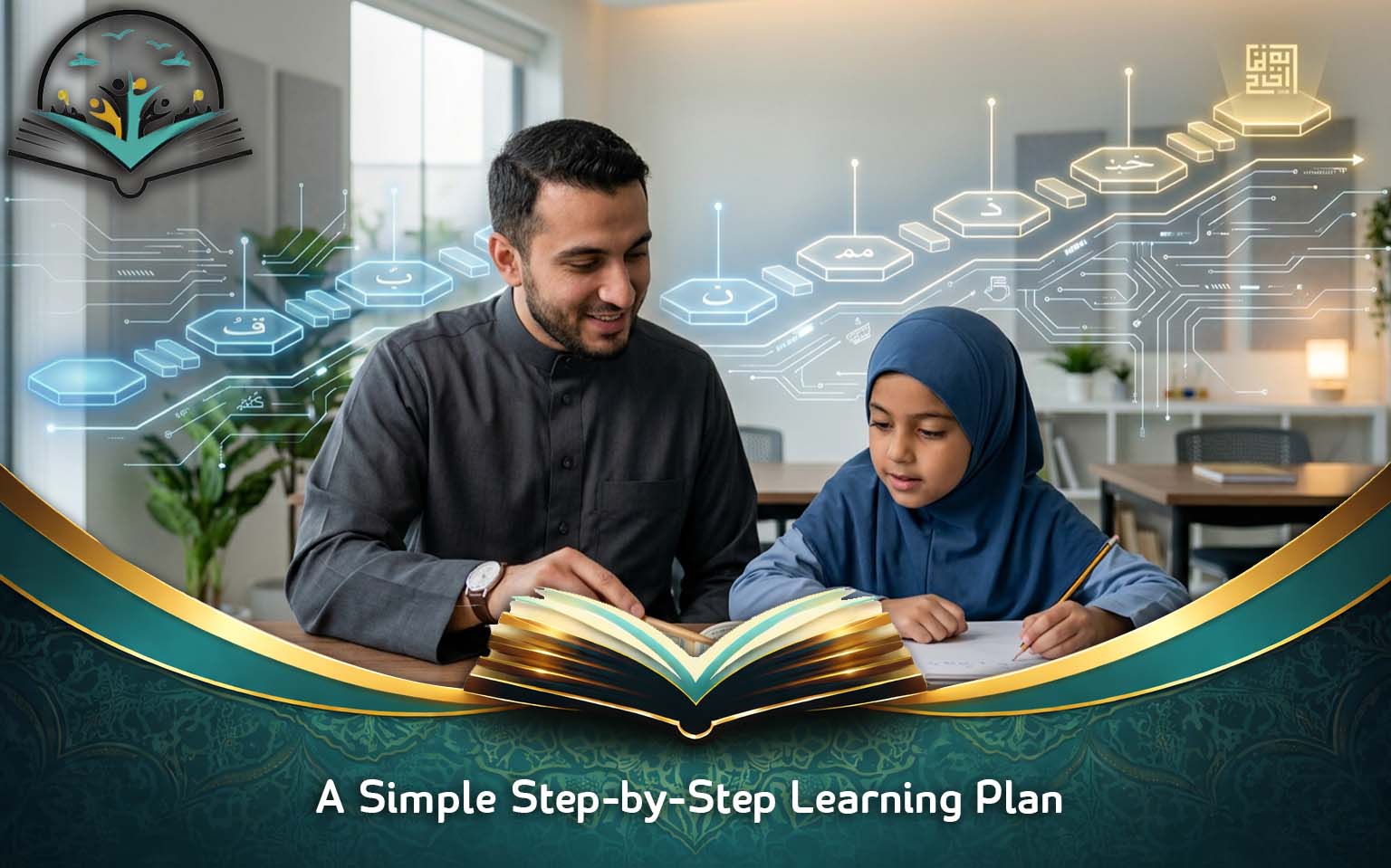
A structured plan helps beginners progress gradually without feeling overwhelmed. Each stage builds an important reading skill and prepares the learner for the next level.
Step 1: Learn the Letters
Begin by recognizing every Arabic letter and practicing its correct basic sound. Focus on accuracy rather than speed.
Step 2: Practice Letter Forms
Learn how Arabic letters may change shape when they appear at the beginning, middle, or end of a word. This makes connected reading easier.
Step 3: Learn the Vowel Signs
Practice Fathah, Kasrah, and Dammah with different letters. Repetition helps learners recognize these signs quickly while reading.
Step 4: Study Long Sounds
Learn how certain letters and vowel combinations produce extended sounds. Practice these patterns until they become familiar.
Step 5: Learn Sukoon and Shaddah
Study Sukoon and Shaddah carefully because both affect how letters are pronounced. Use short examples before moving to longer combinations.
Step 6: Practice Tanween
Gradually practice Tanween and other common reading patterns. Regular repetition can help students apply these rules more naturally.
Step 7: Read Complete Examples
Apply the rules to complete words and increasingly difficult exercises. Reading aloud allows learners to identify and correct pronunciation problems.
Step 8: Begin Quran Reading
Once the foundation is strong, begin reading short Quranic passages with teacher guidance. Continue correcting mistakes instead of rushing through the text.
Step 9: Continue With Tajweed
Build on the foundation by studying more detailed Tajweed rules. Continued practice helps learners improve pronunciation, accuracy, and confidence in Quran recitation.
This progression prevents beginners from feeling that Quran reading is an impossible task. Each stage has a clear purpose.
What is Noorani Qaida's Role in Building Quran Reading Confidence?
Confidence grows when learners understand what they are reading and know how to correct their mistakes. A beginner who struggles with every word may feel nervous when asked to read aloud. However, repeated practice with simple combinations can gradually reduce that anxiety.
The important point is that confidence should come from competence rather than speed. Students should be encouraged to take their time, pronounce each sound carefully, and ask questions when something is unclear.
Over time, familiar patterns become easier to recognize. Reading then becomes less mentally demanding because the learner no longer has to consciously think about every individual letter.
Choosing the Right Learning Environment
The quality of instruction can influence how effectively a student learns foundational Quran reading skills.When selecting an online program, consider whether the teacher:
- Corrects pronunciation directly.
- Gives the learner enough time to read.
- Adjusts lessons according to ability.
- Reviews difficult material.
- Provides regular feedback.
- Encourages questions.
- Uses a structured curriculum.
- Understands the needs of children and adults.
Students should also consider practical factors such as scheduling, lesson length, communication, and consistency.
A good program should make the learner feel supported while still maintaining clear expectations for practice and progress.
Why Consistency Matters More Than Speed
One of the most useful lessons for beginners is that learning is a process. A student may have an excellent lesson one day and struggle during the next lesson. That does not mean progress has disappeared. Learning new sounds and reading patterns requires repetition.
A realistic routine might involve ten to twenty minutes of focused practice each day, depending on the learner's age and ability. The exact amount is less important than creating a routine that can be maintained.
Parents can help children by setting a regular study time. Adults can connect practice with an existing daily habit, such as studying after a particular prayer or at another convenient time.
The goal is to make practice a normal part of the day rather than an occasional activity.
What is Noorani Qaida's Long-Term Benefit?
The long-term benefit is the development of a stronger foundation for Quran reading. A student who learns basic Arabic letters and pronunciation carefully may find later recitation lessons more manageable. The learner can focus on advanced rules instead of repeatedly returning to elementary reading problems.
The benefits can also extend beyond one course. Stronger letter recognition makes reading Quranic text easier, while better pronunciation awareness helps students notice and correct mistakes.
For children, early foundational learning can create positive habits that remain useful as they grow. For adults, it can provide a practical route toward a goal they may have postponed for years.
How Parents Can Support a Child's Learning
Parents play an important role, but they do not need to become the child's teacher. Their role can be to create an environment where learning is consistent and positive.
Parents can:
- Set a regular lesson schedule.
- Provide a quiet study area.
- Encourage daily review.
- Celebrate improvement.
- Avoid embarrassing the child over mistakes.
- Communicate with the teacher about difficulties.
- Make sure the child attends lessons consistently.
- Ask the child to read occasionally without turning practice into pressure.
A child who associates Quran learning with encouragement is more likely to develop a positive attitude toward continued study.
How to Know When a Student Is Ready to Move Forward
A student may be ready to progress when they can read familiar patterns with reasonable accuracy, recognize important signs, and apply previously learned concepts without constant prompting. However, readiness should be judged by ability rather than by the number of pages completed.
A teacher can assess whether the student still struggles with particular letters, vowel combinations, connected forms, or pronunciation patterns. If significant difficulties remain, additional practice may be more useful than moving immediately to harder material. This approach protects the learner from building new skills on an unstable foundation.
What is Noorani Qaida's Place in a Complete Quran Learning Journey?
The Qaida can be viewed as the first major step in a longer learning journey.A student may begin with letter recognition and basic reading. Next comes stronger fluency and more accurate pronunciation. After that, the learner may study Tajweed in greater depth and practice recitation regularly.
Some students may eventually pursue Quran memorization, while others may focus on improving their recitation or understanding Quranic Arabic.
The starting point does not determine the final goal. What matters is establishing a reliable foundation that supports whatever comes next.
Learning With Rattel W Artaqi Quran Academy
Students looking for structured online Quran education can consider Rattel W Artaqi Quran Academy when beginning their foundational reading journey.
A well-organized program should recognize that students have different starting points. A child may need engaging repetition, while an adult may prefer a more direct explanation of pronunciation and reading patterns.
The learning process should therefore remain flexible while maintaining clear educational goals.
At Rattel W Artaqi Quran Academy, beginners can work toward stronger Quran reading skills through guided lessons and consistent practice. Students can use the foundational stage to identify pronunciation challenges before moving toward more advanced Quran studies.
For families, the most useful approach is to focus on steady progress. A student does not need to master everything immediately. With patience, regular lessons, and meaningful practice, difficult concepts can become familiar.
A Practical Daily Routine for Beginners
A simple daily routine helps beginners learn consistently without feeling overwhelmed.
- 5 minutes: Review
- Review examples from previous lessons to strengthen earlier skills.
- 5 minutes: New Material
- Learn one new concept and practice it carefully.
- 5 minutes: Reading Aloud
- Read examples slowly while focusing on correct pronunciation.
- 5 minutes: Correction
- Repeat difficult letters or combinations and correct mistakes.
The routine can change according to age and ability. Children may need shorter sessions, while adults can study longer. The most important factors are consistency, concentration, and regular practice.
What is Noorani Qaida's Most Important Lesson for Beginners?
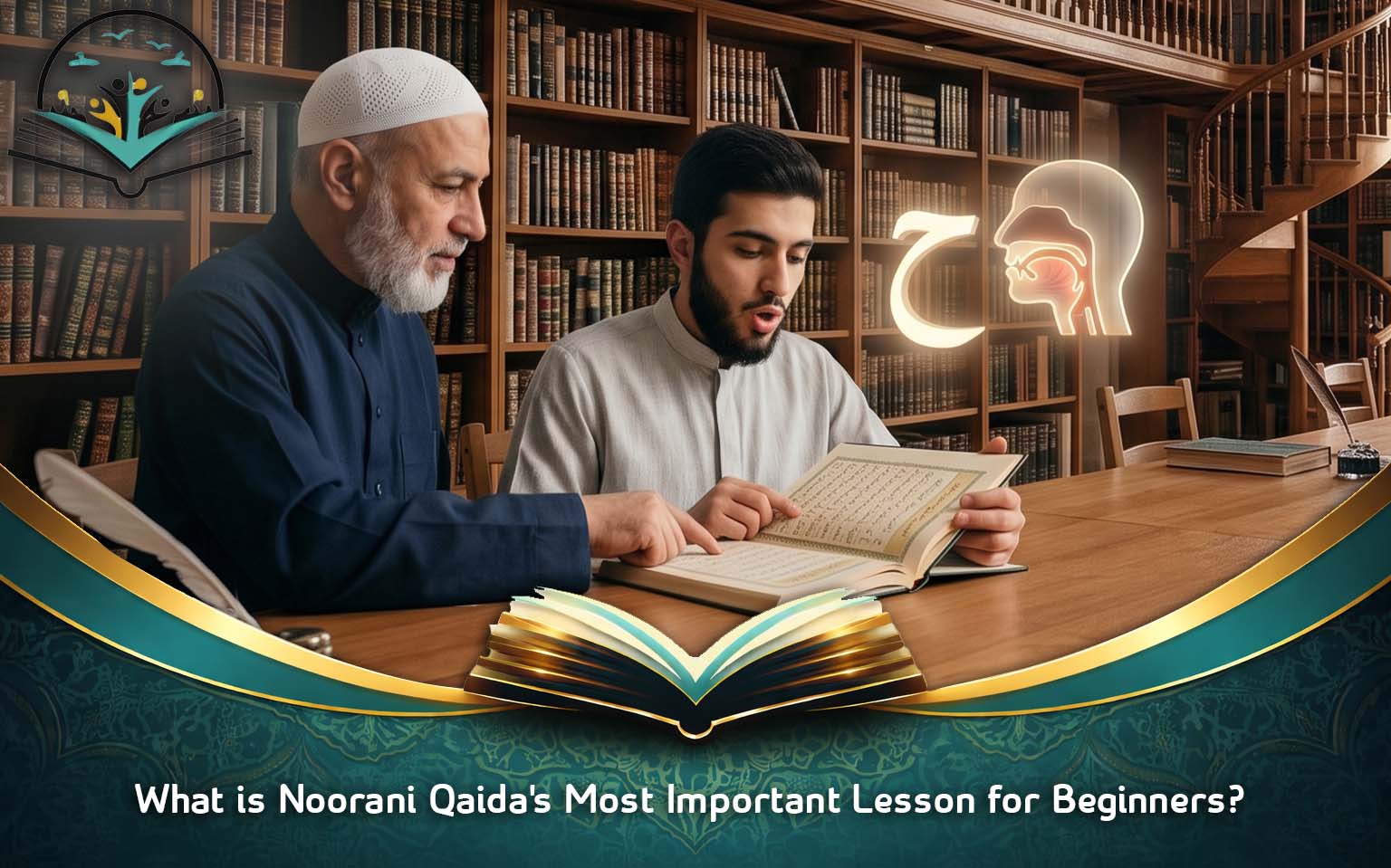
Perhaps the most important lesson is that accurate Quran reading begins with strong fundamentals.
Students sometimes want to reach complete Quranic verses immediately. While that enthusiasm is positive, skipping essential foundations can make the journey harder later.
Learning letters, sounds, vowel marks, connected forms, and basic pronunciation patterns may seem elementary, but these skills form the building blocks of fluent recitation.
A learner who gives these basics the attention they deserve is more likely to approach later Quran studies with confidence.
Frequently Asked Questions
Frequently Asked Questions about learning Noorani Qaida, daily practice, pronunciation, and progressing toward Quran reading and Tajweed.
Is Noorani Qaida suitable for someone who cannot read Arabic at all?
Yes. It is designed as a foundational resource, so complete beginners can start with the Arabic alphabet and basic sounds before progressing to connected reading.
Can someone learn it without memorizing Arabic vocabulary?
Yes. Learning to read Arabic script does not require fluency in Arabic vocabulary. Students can develop reading skills separately from understanding the language.
Should students study from a printed book or digital version?
Either can work. The most important factor is clear material combined with regular guided practice. Digital resources can be convenient for online lessons, while printed copies may be helpful for focused study.
Is it necessary to read aloud during practice?
Yes. Reading aloud allows learners to connect what they see with how the sound should be produced. It also makes pronunciation mistakes easier to identify and correct.
What should a student do after completing the Qaida?
The next step depends on the learner's goals and ability. Many students begin more consistent Quran reading and then study Tajweed to improve pronunciation, fluency, and recitation quality.
In conclusion, What is Noorani Qaida is becomes easier to understand when it is viewed as a foundation rather than simply a small book. Its purpose is to guide beginners through the essential skills required to recognize Arabic letters, pronounce them correctly, understand common reading signs, connect letters, and gradually develop confidence with Quranic text.
For children and adults alike, the most effective approach combines structured lessons, regular practice, careful listening, and direct correction. Students should not measure success only by how many pages they complete. Accuracy, confidence, consistency, and improvement are much more meaningful indicators.
Learning at a comfortable pace also matters. Some students will progress quickly, while others need additional repetition. Both paths are normal. What matters is continuing to practice without becoming discouraged by mistakes.
If your goal is to build a reliable foundation before progressing to Quran recitation and Tajweed, studying with a qualified teacher can make the process clearer and more manageable. Rattel W Artaqi Quran Academy can provide a structured environment for learners who want guidance as they develop their Quran reading skills.
With consistent effort and the right support, the first steps that once seemed difficult can become familiar. The journey begins with the basics, and a strong foundation can make every later stage of Quran learning more rewarding.
Add New Comment