 العربية
 English

Learning to recite the Quran is one part of a Muslim's education. Understanding belief, worship, character, and the life of the Prophet is another, and it is the part most often left to chance for families living outside Muslim majority countries. Our Islamic Studies course provides that grounding in a structured way, taught one on one by a qualified teacher and adapted to the student's age and existing knowledge.
What the Course Covers?
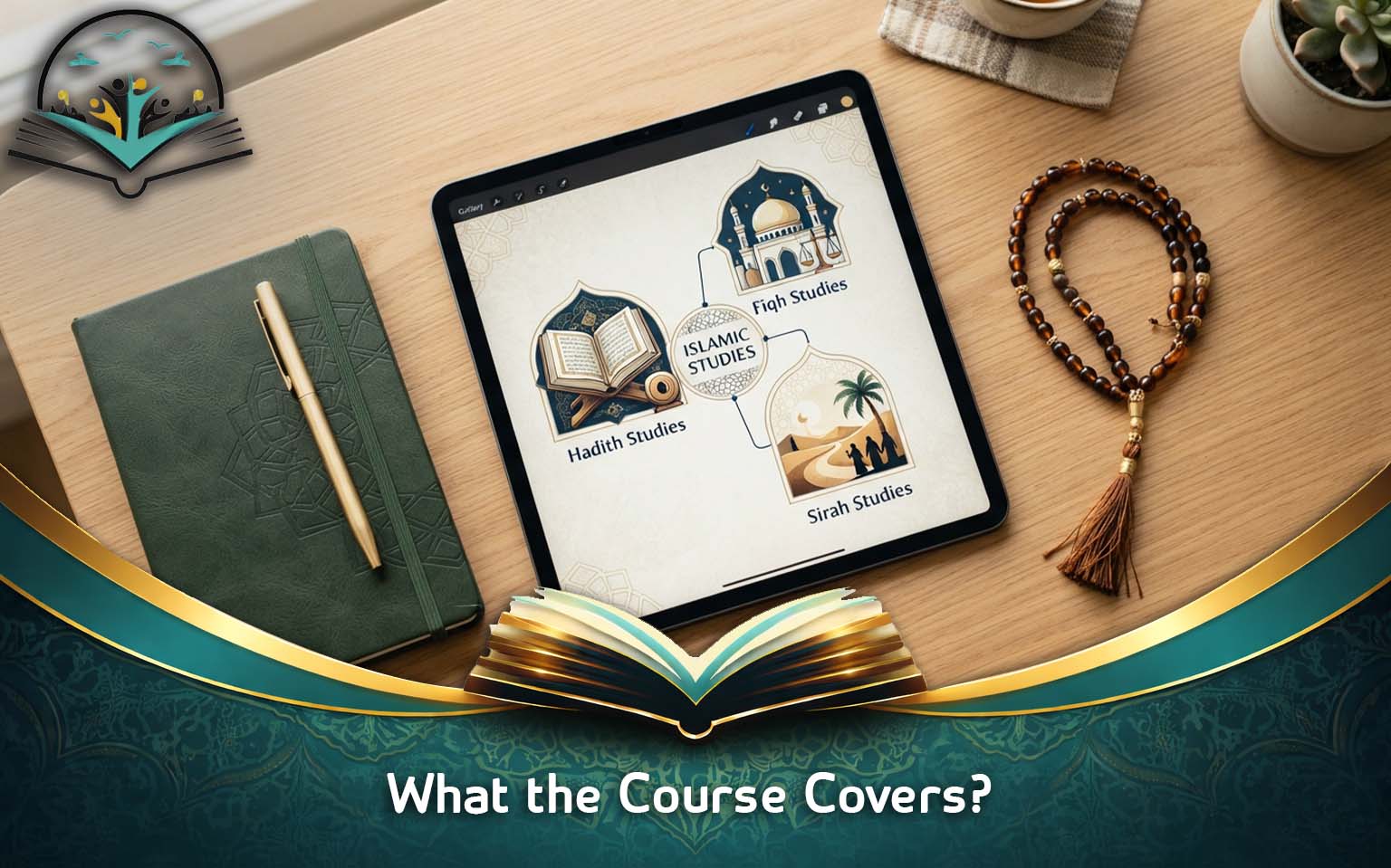
The course is organized around several connected areas rather than treated as a single undifferentiated subject. Teachers move between them according to the student's level and needs.
Belief
The foundations of Islamic belief, taught clearly and at a level appropriate to the student. For children this means simple, concrete explanation. For older students and adults it allows for more depth and for the questions that naturally arise from living in a religiously mixed environment.
Worship and Its Rulings
The practical rulings governing acts of worship, including purification, prayer, fasting, zakah, and pilgrimage. The emphasis is on what a student needs in order to perform these correctly and with understanding, rather than on abstract legal discussion.
Students focused specifically on prayer, and parents wanting their children to learn it properly, can also look at our guide to Namaz classes for kids.
The Life of the Prophet
The events of the Prophet's life studied in sequence, with attention to the lessons drawn from them. Seerah gives students a coherent narrative that connects belief and practice to real historical events, which for younger students in particular makes the material considerably easier to absorb.
Character and Manners
Islamic teaching on conduct, including honesty, patience, treatment of parents, behaviour toward neighbours, and manners in everyday interaction. This area is frequently the most immediately practical, especially for children navigating school and friendships.
Supplications for Daily Life
The supplications associated with everyday actions, taught with their meanings so that students understand what they are saying rather than repeating unfamiliar sounds. Our daily duas classes cover this area in more depth for students who want to focus on it.
Deepen Your Islamic Knowledge Today
Ready to expand your understanding of Islam? Join Rattel W Ertaqi for structured Islamic Studies lessons designed to help learners explore essential knowledge, strengthen their understanding, and develop a meaningful connection with Islamic teachings.
Who This Course Is For?
The course is designed for students of all ages, and the approach differs substantially between them.
Children benefit from clear, age appropriate teaching that builds understanding gradually rather than requiring memorization of material they cannot yet make sense of. Parents commonly enrol children who attend non-Muslim schools and have little structured Islamic education otherwise.
Teenagers often have more searching questions, particularly where they encounter ideas at odds with what they have been taught at home. Teachers engage with these questions directly rather than deflecting them.
Adults join for varied reasons, including filling gaps from their own upbringing, preparing to teach their children, or building knowledge alongside Quran study. Our classes for adult learners are built around adult schedules and expectations.
How Classes Work?
Classes are live and one on one with a qualified teacher. This allows the teacher to pitch explanations at the right level, follow the student's actual questions, and confirm genuine understanding rather than surface recall.
The one to one format matters particularly here, since students bring very different backgrounds. A student raised in a practising household needs something different from one encountering structured Islamic teaching for the first time, and a group class cannot accommodate both well.
Students usually attend between two and five sessions per week. Families with weekday constraints can arrange weekend Quran classes, and those wanting to understand the format better can read about one to one Quran classes.
Accuracy and Sources
Teachers present material as it is established in recognized scholarship. Where scholars differ on a question, students are told that a difference exists rather than being given one position presented as the only view. Where a question falls outside what a teacher can properly answer, the student is told so and directed appropriately.
This matters more in Islamic Studies than in most subjects, because students frequently arrive with information gathered from unreliable sources online, and part of the teacher's role is correcting it carefully.
How This Fits With Quran Study?
Islamic Studies works well alongside recitation and memorization. Students who understand the context and meaning of what they recite tend to engage with it more seriously, which supports work in our Hifz course.
Students wanting to go further into the meaning of the text itself often continue into our Tafseer course, which examines the Quran passage by passage.
Progress and Feedback
Teachers keep a record of topics covered and note where understanding is incomplete. Parents of younger students receive regular updates on what their child has learned and where reinforcement at home would help.
Because this subject is about understanding rather than performance, teachers assess through discussion and questioning rather than testing recall alone.
Getting Started Islamic Studies Course
Every student begins with a free trial class. The teacher gets a sense of existing knowledge, discusses what you or your child most need, and proposes a starting point. No prior study is assumed.
Pricing details are on our fees and class schedule page, and you can browse the complete set of Quran learning resources at the academy.
Frequently Asked Questions
Find answers to frequently asked questions about the Islamic Studies Course, including subjects covered, lesson structure, teaching methods, and enrollment.
What age should a child start?
Children can begin once they are able to follow a short discussion and answer simple questions. Teachers adjust content and session length to suit younger students.
Do I need to know Arabic?
No. Classes are taught in English, and Arabic terms are explained as they arise. Students wanting to study the language separately can look at our Arabic language course.
Can I request a male or female teacher?
Yes. Classes are available with male Quran teachers and with female teachers for sisters.
Can the course focus on one area?
Yes. If you want to concentrate on prayer, character, or seerah specifically, tell your teacher in the trial class and the plan will be built around that.
In conclusion, An Islamic Studies Course can help students build a deeper understanding of Islamic beliefs, values, history, and essential teachings. With a structured curriculum and guidance from knowledgeable instructors, learners can explore important subjects clearly and engagingly.
Rattel W Ertaqi offers an educational environment where students can develop their knowledge while connecting Islamic learning with everyday life.
Whether you are studying independently or looking for guided instruction, consistent learning can strengthen your understanding and confidence. Begin your journey with a reliable educational approach designed to make Islamic studies accessible, meaningful, and beneficial.
What Kids Learn in Our Islamic Studies Classes
The course covers the practical foundations of Islam that children need growing up: how to perform wudu and pray correctly, the meaning behind daily duas, basic manners and character (Akhlaq), stories of the Prophets told in an age appropriate way, and an introduction to the pillars of Islam. Lessons are built around real understanding rather than rote memorization, so children can explain what they have learned in their own words.
Age Groups We Teach
We work with children from around five years old through the teenage years, adjusting both the content and teaching style for each age group. Younger children get shorter, more interactive sessions with stories and simple activities, while older kids and teenagers cover more detailed topics and are encouraged to ask questions and discuss what they are learning rather than simply listening.
How This Complements Quran Classes
Many families pair Islamic Studies with our Noorani Qaida classes so children build reading skills and religious understanding side by side, rather than treating them as separate, disconnected subjects. Understanding the meaning and context behind what they read tends to make the Quran itself feel more relevant to daily life.
Why Parents Choose Structured Online Islamic Studies
Finding a nearby Islamic school or weekend program is not always possible, especially for families outside major Muslim communities. Online Islamic Studies classes let parents give their children a consistent, qualified religious education regardless of location, on a schedule that fits around school and other activities, with a dedicated teacher who gets to know the child over time rather than a rotating group class.
Frequently Asked Questions
Is this class only for children who already read Quran?
No. Islamic Studies can be taken independently or alongside Quran reading classes, whichever fits your child's needs.
How do you keep young children engaged online?
Our teachers use stories, questions, and short interactive segments rather than long one-directional lectures, which keeps younger students focused.
Can parents sit in on the classes?
Yes, parents are always welcome to observe, and many find it helpful to reinforce the lessons at home during the week.
Ready to enroll your child? Check our fees or book a free trial class to see how your child responds to the teaching style.