 العربية
 English

Most Muslims outside the Arab world recite the Quran without understanding what they are reciting. Our Arabic Language course exists to close that gap. It teaches Arabic as a language you can actually read and understand, with an emphasis on the vocabulary and grammar that appear most frequently in the Quran, so that study translates directly into comprehension of the text.
What This Arabic Language Course Covers?
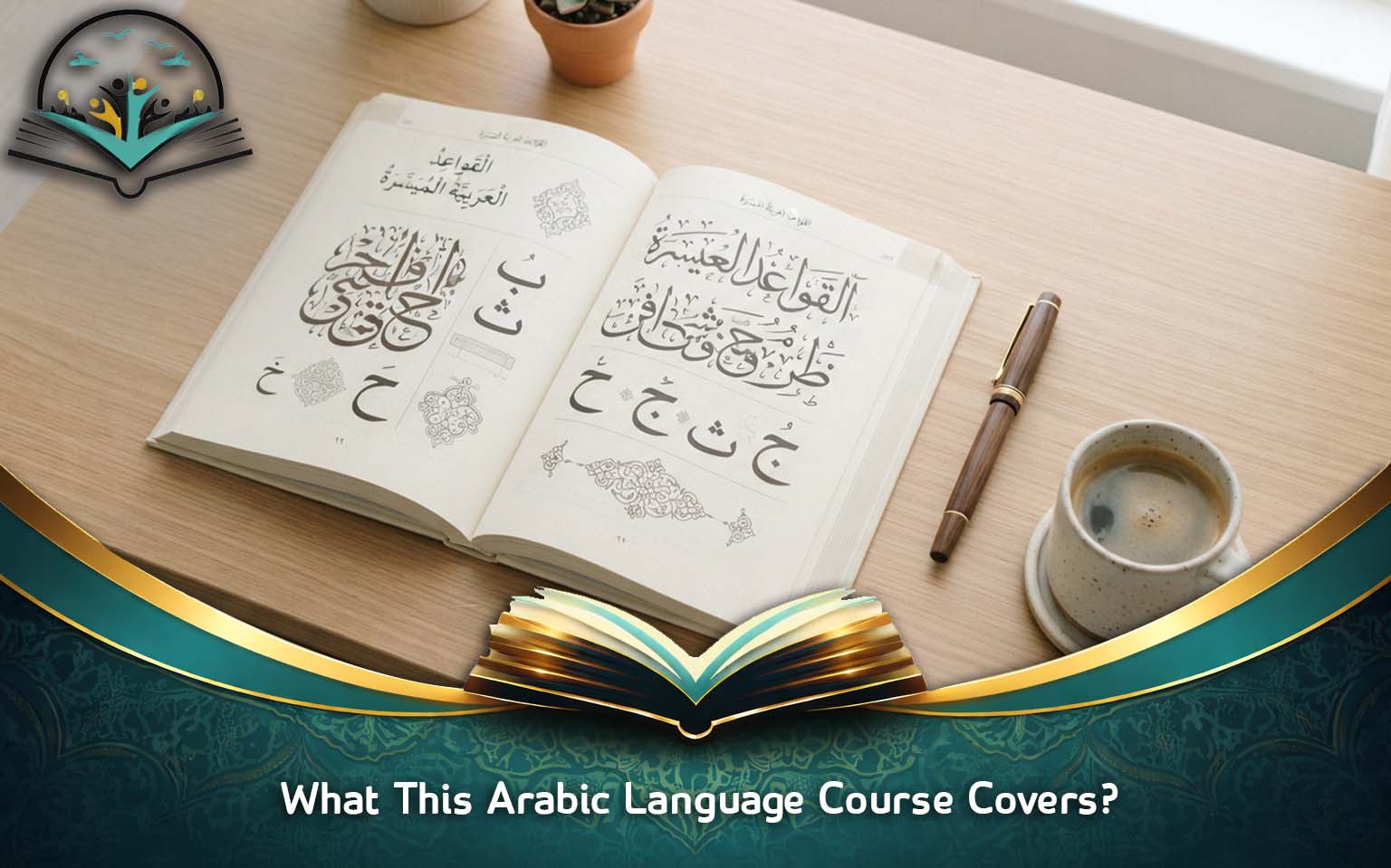
The course develops reading and comprehension in a structured sequence, moving from foundations through to reading connected passages with understanding.
Vocabulary Building
Students build vocabulary systematically, prioritizing the words that occur most often. Quranic Arabic relies heavily on a relatively limited core vocabulary that repeats throughout the text, which means well chosen early study yields disproportionate results in comprehension.
Root Patterns
Arabic words are built from roots, usually of three letters, which carry a core meaning shared across every word derived from them. Learning to recognize roots allows students to work out unfamiliar words rather than memorizing each one in isolation, and it is one of the most useful skills the course develops.
Grammar and Sentence Structure
Students learn how Arabic sentences are constructed, how words change according to their role, and how these changes affect meaning. Grammar is taught through examples drawn from real usage rather than as abstract rules to be memorized.
Verb Forms and Tenses
Arabic verbs shift according to tense, subject, and derived pattern. The course works through these systematically, since verbs carry much of the meaning in any sentence and misreading them changes the sense of a passage entirely.
Reading Connected Text
As the foundations settle, students move to reading connected passages and working out meaning from the text itself rather than relying on translation.
Start Learning Arabic with Confidence
Build stronger Arabic skills with structured lessons and dedicated guidance at Rattel W Ertaqi. Begin your learning journey today and develop the language abilities you need for communication, study, and a deeper understanding of Arabic texts.

Who This Course Is For?
The course is designed for non-Arabic speakers of all ages, and students join with a range of goals.
Some want to understand the Quran directly rather than through translation. Others are preparing for advanced study in Tafseer or Islamic sciences, both of which become far more accessible with working Arabic. Parents often learn alongside their children, and adults returning to study after years away form a substantial group. Our classes for adult learners are structured with adult schedules and learning styles in mind.
Students should ideally be able to read Arabic script before starting, since the course focuses on language rather than reading mechanics. Those who cannot yet read the script usually begin with our Noorani Qaida course, which builds that skill first.
How Classes Work?
Classes are live and one on one with a qualified teacher. Language learning depends on producing the language and being corrected, which a recorded lesson cannot provide. Students read aloud, translate, answer questions, and construct sentences while the teacher corrects errors as they occur.
Sessions typically run two to five times per week. Language study rewards frequency more than length, since regular exposure is what moves vocabulary and structures into long term memory. Students with limited weekday availability can arrange weekend Quran classes instead.
Teachers assign review between sessions, usually short and focused. Consistent daily review produces markedly better results than concentrated study before a lesson.
How This Supports Quran Study?
Arabic transforms every other area of Quran study. Students who understand what they are reciting memorize more effectively, because meaning provides structure that pure sound does not. Those studying our Hifz course frequently report that memorization becomes easier once comprehension improves.
Arabic also opens the way to deeper study of the text. Our Tafseer course and Quran translation course both become considerably more valuable to students who can engage with the original wording rather than depending entirely on a translator's choices.
Progress and Feedback
Teachers track vocabulary covered, grammatical structures introduced, and areas where a student consistently hesitates. Review is then targeted at genuine weak points instead of covering everything evenly.
Progress in language study can feel slow in the early stages, since a great deal is absorbed before it becomes usable. Teachers therefore point out concrete markers of progress, such as passages a student can now read unaided that would have been impossible weeks earlier.
Getting Started Arabic Language Course
Every student begins with a free trial class. The teacher assesses your current level, discusses your goals, and outlines a realistic plan. Complete beginners in the language are welcome, provided reading of the script is reasonably secure.
Pricing is set out on our fees and class schedule page, and the full range of Quran learning resources is available to browse.
Frequently Asked Questions
Explore answers to common questions about the Arabic Language Course, including levels, curriculum, lessons, learning goals, and student support.
How long before I can understand the Quran directly?
This depends on starting level, study frequency, and review between lessons. Partial comprehension of simpler passages usually comes well before full independent reading. Your teacher will give a realistic estimate once your pace is established.
Is this classical or modern Arabic?
The focus is on the classical Arabic of the Quran. There is considerable overlap with modern standard Arabic, so students gain useful ability in both, though the course prioritizes Quranic usage.
Do I need to read Arabic script first?
Yes, ideally. If you cannot, your teacher will recommend starting with foundational reading, and our guide to Quran classes for beginners explains that stage.
Can children take this course?
Yes. Teachers adjust pace and explanation for younger students, who often absorb vocabulary quickly given consistent exposure.
Can I request a male or female teacher?
Yes. Classes are available with male Quran teachers and female teachers for sisters.
In conclusion, Learning Arabic can open the door to better communication, deeper cultural understanding, and greater access to important Islamic and classical texts. An organized Arabic Language Course gives students the opportunity to develop vocabulary, grammar, pronunciation, reading, and communication skills through regular practice.
At Rattel W Ertaqi, learners can study Arabic through structured lessons and supportive instruction suited to their individual needs and goals.
Whether you are a beginner or looking to improve existing skills, consistent guidance can make your learning journey more productive. Start building your Arabic abilities and gain greater confidence with every lesson.
Why Learn Arabic Alongside Quran Studies?
Understanding Arabic changes how the Quran feels to read. Instead of reciting words you cannot fully connect with, you start recognizing roots, grammar patterns, and meaning as you go, which makes memorization and Tajweed study more meaningful rather than purely mechanical. Many of our students begin this course specifically because they want their Quran classes to feel less like memorized sound and more like genuine understanding.
Course Levels We Teach
We structure Arabic learning in stages rather than a single fixed syllabus. Beginners start with the alphabet, basic vocabulary, and simple sentence structure. Intermediate students move into grammar rules, verb conjugation, and reading comprehension. More advanced students focus on Quranic Arabic specifically, working directly with verses to build the vocabulary and grammar needed to understand the text without a translation.
Who Is This Course For?
This course suits non-Arabic speaking Muslims who want to understand their daily prayers and Quran recitation more deeply, new Muslims building their Arabic from scratch, parents who want to support their children's Quran education at home, and anyone preparing for more advanced Islamic studies where Arabic fluency is expected.
How Arabic Supports Your Other Courses
Students taking Arabic alongside our Tajweed classes often find that letter pronunciation and articulation points become easier to grasp, since they understand the linguistic reasoning behind the rules rather than memorizing them by repetition alone. It is not a requirement for our Quran courses, but it consistently makes the whole learning journey faster.
Frequently Asked Questions
Do I need any Arabic background to start?
No. The course is designed to work from absolute zero, with lessons structured so complete beginners are never lost.
Is this the same as Quranic Arabic only?
Not exactly. We cover conversational and grammatical Arabic first, then move into Quranic vocabulary and structure once you have a solid base.
How many classes per week should I take?
Most students see steady progress with two classes a week, though your teacher can adjust this based on your goals and availability.
Interested in starting? View our course fees or book a free trial class to discuss the right starting level for you.
Class Format and Materials
Classes are conducted one to one online, using shared digital worksheets, vocabulary lists, and short reading passages tailored to your level. Your teacher tracks your progress across sessions and adjusts the material as you improve, rather than following a rigid textbook from start to finish regardless of pace. This flexibility is especially useful for adult learners balancing work or family commitments alongside their studies.
Whether your goal is basic conversational comfort, helping your children with schoolwork, or reaching full Quranic comprehension, we build a plan around your specific reason for learning rather than a one size fits all curriculum.