 العربية
 English


Online Quran Classes vs. In-Person Classes is a comparison that many parents, adults, and Quran learners make before choosing the right learning environment. Both options can support Quran reading, Tajweed, memorization, and regular practice. However, the experience can be very different depending on the student's age, learning style, schedule, goals, and access to qualified teachers.
For some learners, studying from home makes it easier to attend regular lessons and receive focused guidance. Others benefit from being physically present with a teacher and classmates. Therefore, the better question is not simply whether online or in-person learning is better. Instead, you should ask which format gives the learner the conditions needed to study consistently and make meaningful progress.
Rattel W Artaqi Quran Academy approaches online Quran learning as a structured educational experience rather than simply a video call. The goal is to give learners a clear learning path while allowing families to consider their own schedules, learning needs, and preferences.
Online Quran Classes vs. In-Person Learning: Key Differences
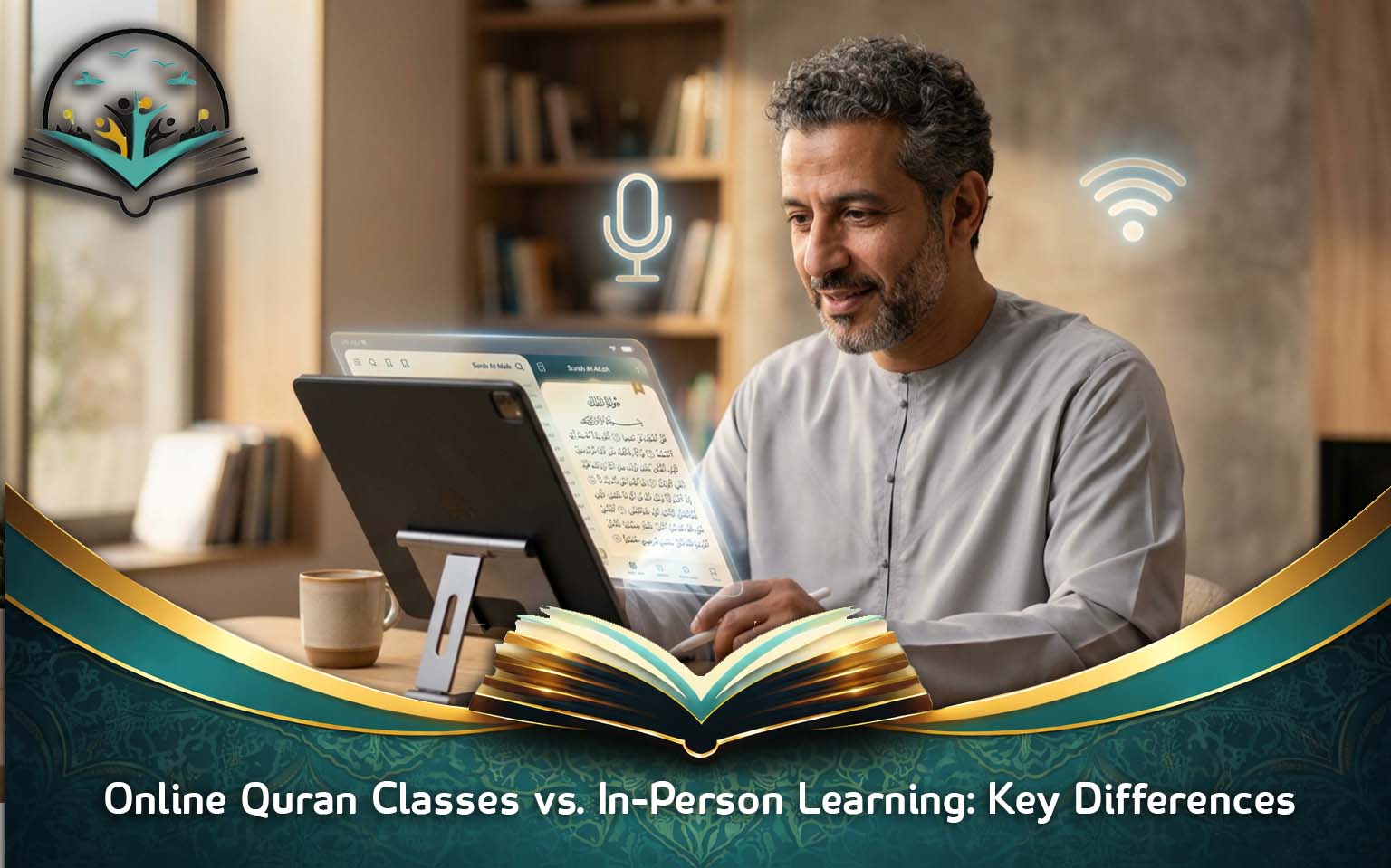
At first glance, the difference seems simple: one option takes place through the internet, while the other requires the student to attend a physical location. In practice, however, several factors separate the two approaches.
| Factor | Online Learning | In-Person Learning |
|---|---|---|
| Location | Study from home | Requires travel |
| Teacher choice | Wider geographic access | Usually depends on local availability |
| Individual attention | Often easier to arrange one-to-one | Depends on class size |
| Scheduling | Generally more flexible | Usually follows fixed times |
| Peer interaction | More limited | Naturally available |
| Travel time | No regular commute | Travel may be required |
| Home involvement | Parents can observe more easily | Parents may have less direct visibility |
| Learning environment | Requires a suitable home setup | Dedicated physical classroom |
These differences matter because Quran learning is built through regular practice. A format that looks convenient may become difficult if the learner cannot attend consistently. Similarly, a traditional classroom may provide social interaction but become impractical when transportation or scheduling creates repeated absences.
For that reason, Online Quran Classes vs In-Person Classes should be evaluated according to the learner's actual circumstances rather than general assumptions.
Begin Your Spiritual Journey With Trusted Quran Guidance
Take the next step toward deeper Quran understanding with Rattel W Artaqi Quran Academy and start learning with confidence today. Our experienced teachers provide supportive online classes designed for children, adults, and beginners who want to improve recitation, Tajweed, and Islamic knowledge.
We focus on clear explanations, flexible schedules, and practical learning that fits your daily life. Join our academy now and build a stronger connection with the Holy Quran through engaging lessons that inspire spiritual growth, discipline, and lasting faith for every student.

What Makes Online Quran Classes Different?
Online Quran learning changes where and how the lesson takes place. Instead of travelling to a mosque, school, or learning center, the student connects with the teacher from home.
This arrangement can be particularly useful for families with demanding schedules. A child may complete school, have a short break, and then attend a Quran lesson without spending additional time travelling. Adults can also fit lessons around work, family responsibilities, or other commitments.
Another important difference is teacher access. A student is not necessarily restricted to teachers who live nearby. Depending on the program, online learning can make it possible to study with a teacher whose experience matches the student's needs even when that teacher is not available locally.
Rattel W Artaqi Quran Academy can therefore be considered by learners who want a structured online environment while keeping lessons within their home routine.
Online Quran Classes vs In-Person Classes for Individual Attention
Individual attention is one of the most important factors in the Online Quran Classes vs In-Person Classes discussion.
In a one-to-one lesson, the teacher can listen closely to the student's recitation and identify specific areas that need correction. The learner can also ask questions without waiting for other students to finish.
That difference becomes especially relevant when studying pronunciation and Tajweed. A small mistake in a letter, vowel, or rule may need immediate correction before it becomes a repeated habit.
By comparison, an in-person group class can divide the teacher's attention among several learners. That does not make classroom learning ineffective. Rather, the amount of individual practice depends heavily on the number of students and the structure of the lesson.
Therefore, when comparing the two formats, do not focus only on whether the lesson is online or physical. Ask how much time the learner actually spends reading, receiving corrections, asking questions, and practising independently.
Teacher Choice and Access
Teacher availability can strongly influence the learning experience. A learner living in an area with only a few Quran teachers may have limited options. The nearest teacher might have a full schedule, teach only certain age groups, or use a teaching approach that does not match the student's needs.
Online learning changes this limitation because the teacher does not need to live in the same city.
As a result, learners may have greater flexibility when looking for a teacher based on experience, teaching style, language, schedule, or specialization. This can be particularly useful for families living in areas where suitable local Quran instruction is difficult to find.
Rattel W Artaqi Quran Academy can provide an online alternative for learners who prefer to access Quran instruction without making teacher selection dependent entirely on geographical proximity.
Online Quran Classes vs In-Person Classes for Scheduling
Scheduling is another major part of the Online Quran Classes vs In-Person Classes comparison. An in-person lesson often includes more than the teaching time itself. Families may need to prepare the child, travel to the location, wait during the lesson, and return home afterward. Even a short lesson can therefore occupy a considerable part of the evening.
Online lessons remove the regular commute. Once the learner has a suitable study space and the necessary technology, the student can join the lesson from home.
This can make frequent lessons easier to organize. For example, a family that struggles to dedicate one long evening to travel may find shorter online sessions easier to maintain.
However, convenience should not become the only consideration. A flexible schedule is valuable only when the learner actually uses it for consistent study.
How Consistency Affects Quran Learning?
Quran learning requires repetition. Students need opportunities to read, listen, recite, review, and correct mistakes over time. Consequently, the most convenient format is often the one that the learner can maintain regularly.
Online learning can remove several common barriers, including transportation, weather, and long commutes. If those obstacles previously caused missed lessons, studying from home may make attendance easier.
In-person learning, on the other hand, can create a stronger physical routine. Some learners find that travelling to a dedicated classroom helps them separate study time from the distractions of home.
The key issue is therefore not which format is universally more consistent. Instead, consider which environment makes regular attendance realistic for this particular learner.
Online Quran Classes vs In-Person Classes for Children
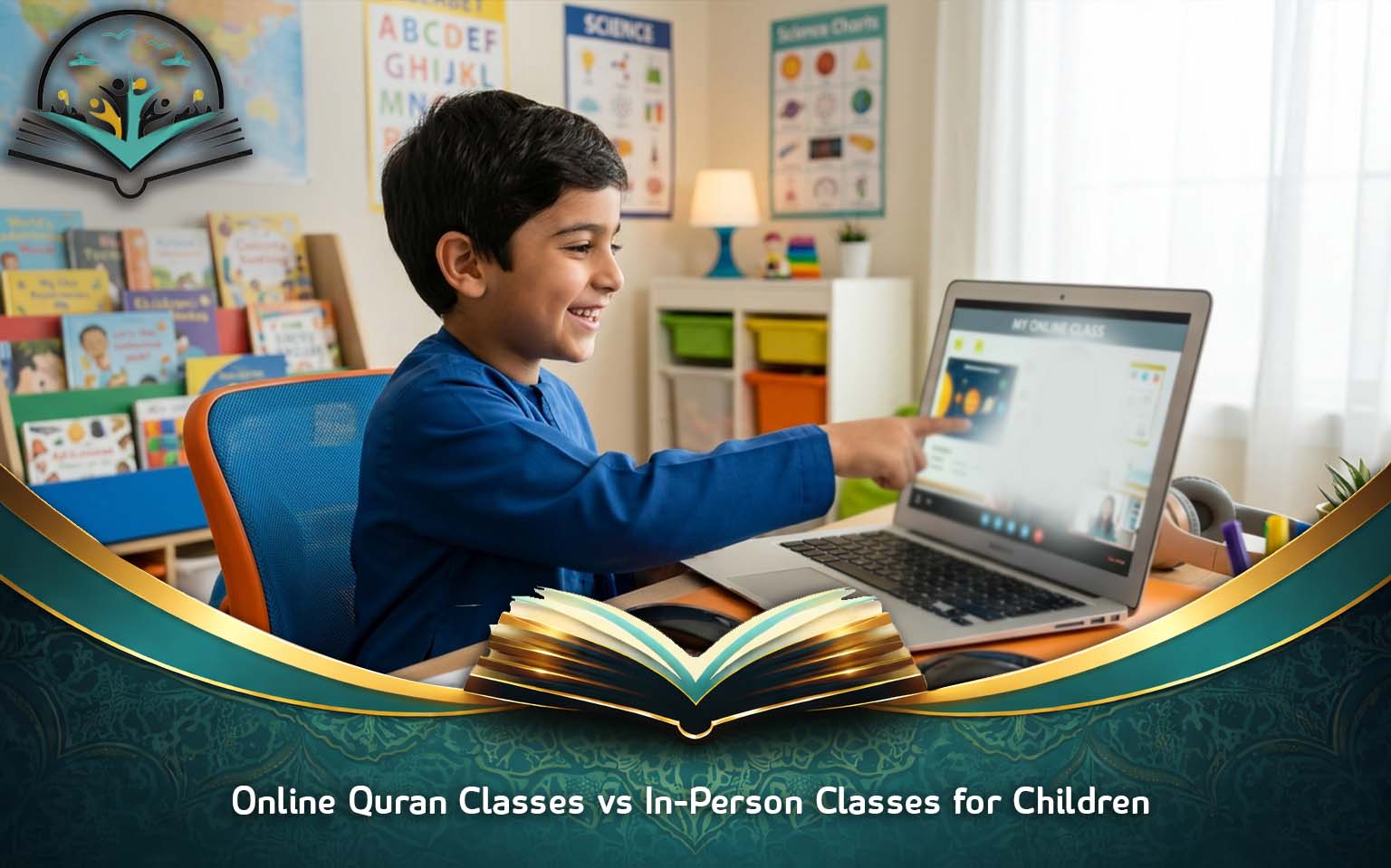
Children require a slightly different evaluation. Young learners may benefit from the structure of a physical classroom because they can see the teacher, interact with other children, and participate in activities outside the screen.
At the same time, online lessons can work well when the child receives focused attention and has a quiet place to study. Parents can also remain nearby when necessary and observe how the lesson is progressing.
Age is important, but it is not the only factor. A child's attention span, personality, previous learning experience, and comfort with technology can all influence the result.
For example, a child who enjoys direct interaction with classmates may become more motivated in a physical group. Another child may feel more comfortable asking questions during a private online lesson.
When considering Online Quran Classes vs In-Person Classes for children, parents should therefore evaluate the individual child rather than assuming that one format works for every age group.
Online Quran Classes vs In-Person Classes for Adults
Adults often have different priorities from children. Work schedules, family responsibilities, commuting, and changing daily routines can make fixed-location classes difficult to maintain. An adult learner may also prefer studying privately rather than joining a group with students at different levels.
Online lessons can address some of these challenges by allowing the learner to study from home.
Privacy can also matter for beginners. Someone who has never learned Quran reading may feel more comfortable practising in a one-to-one setting where mistakes can be corrected without worrying about other students.
At the same time, some adults prefer the atmosphere of a mosque or physical learning center. The sense of being in a dedicated religious environment can encourage them to take the lesson seriously.
Thus, Online Quran Classes vs In-Person Classes for adults often comes down to the balance between flexibility, privacy, personal interaction, and routine.
The Role of Community in Quran Learning
One area where physical learning can offer a distinct experience is community. A physical Quran class brings learners together in the same space. Students may listen to one another, form friendships, participate in group activities, and develop a stronger connection with the local community.
These experiences are difficult to reproduce fully through an individual online lesson. However, online learning does not have to mean complete isolation. Families can combine online Quran lessons with mosque attendance, Islamic events, family revision, or community activities.
This distinction is important because learning and community are related but not identical goals. A student may receive excellent individual instruction online while developing community connections through other activities.
Therefore, when assessing Online Quran Classes vs In-Person Classes, separate the educational needs from the social needs. This makes the decision much clearer.
Online Quran Classes vs In-Person Classes for Tajweed
Tajweed requires careful listening and repeated correction. Students need to understand how letters are pronounced, how sounds change in different situations, and how recitation rules affect the reading. For a deeper understanding of this skill, learners can explore the Importance of Learning Quran with Tajweed.
An online lesson can support this process when the audio and video connection is clear, and the teacher pays close attention to the student's recitation.
The teacher can listen to individual words, identify mistakes, demonstrate the correct pronunciation, and ask the learner to repeat the passage.
Physical lessons provide another advantage: the teacher and student occupy the same space. This can make certain visual demonstrations easier, particularly when the learner needs to observe mouth or tongue positioning.
Still, the quality of instruction matters more than the location alone. A physical classroom with limited individual practice may not automatically provide more correction than a focused online lesson.
Technology Requirements for Online Quran Learning
Online learning does require a basic technical setup. Before starting, families should consider:
- A reliable internet connection.
- A device with a clear camera and microphone.
- Headphones or speakers that allow the learner to hear pronunciation clearly.
- A quiet place with limited interruptions.
- A suitable Quran or digital learning material.
- Enough lighting for clear video communication.
These requirements are usually straightforward, but they should not be ignored.
Technical problems can interrupt concentration and reduce the value of a lesson. For that reason, families should test their equipment before committing to a regular schedule.
Rattel W Artaqi Quran Academy can be considered by learners who want the convenience of studying remotely while maintaining a dedicated learning routine at home. Before making a decision, learners can also review How to Choose the Right Online Quran Academy.
The Home Learning Environment for Online Quran Classes
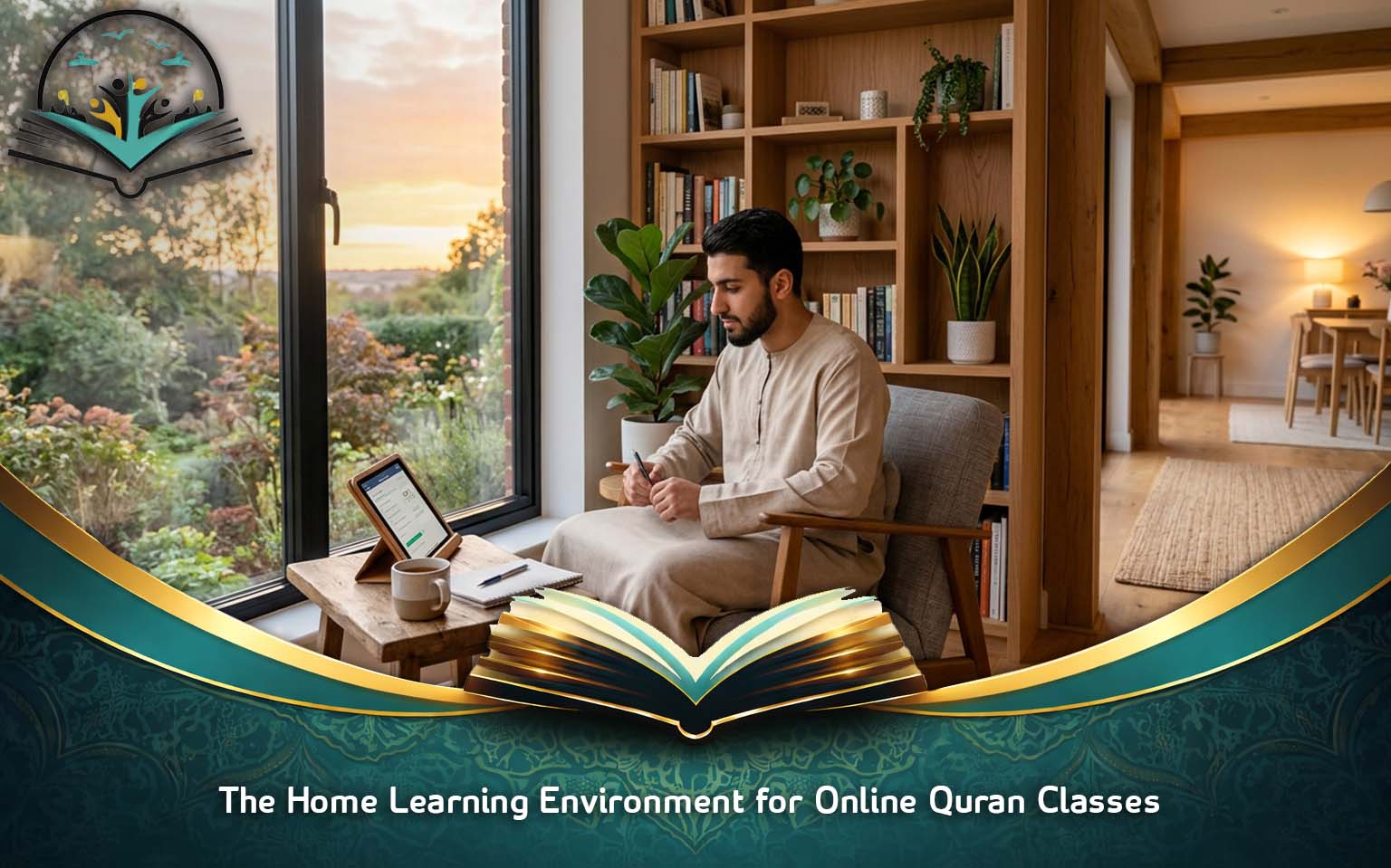
Studying at home can be convenient, but convenience does not automatically create a good learning environment.
A child sitting beside a television, mobile phone, or noisy family gathering may struggle to concentrate even when the teacher is excellent.
Instead, create a simple study area where the learner knows that Quran time is different from ordinary screen time.
The space does not need to be elaborate. A comfortable chair, suitable lighting, a stable internet connection, and the necessary learning materials may be enough.
Parents can also establish a short pre-lesson routine. Preparing the Quran, joining the lesson a few minutes early, and removing unnecessary distractions can help the learner transition into study mode. Parents who are preparing a child for remote study may find How to Prepare Your Child for Online Quran Classes useful.
In this way, the home environment becomes part of the learning process rather than an obstacle to it.
Online Quran Classes vs In-Person Classes and Parental Involvement
Parents often have greater visibility into an online lesson because the student is learning at home.
That can be useful for younger children. A parent may notice whether the child is prepared, whether the environment is quiet, and whether the student is following the lesson.
However, parental involvement should support the learner without taking over the lesson.
Older children and adults generally need enough independence to interact directly with the teacher. Constant parental interruption can make the lesson less natural.
In-person learning can reduce this temptation because the teacher and student are physically separated from the parent during the class.
Consequently, Online Quran Classes vs In-Person Classes is also partly a question of how much involvement the family wants during the learning process. Teacher selection can also affect the learning experience, so families may want to consider Female vs Male Quran Teachers: Which is Better.
Which Format Offers More Flexibility?
Flexibility has several meanings. It can refer to lesson times, teacher selection, location, lesson frequency, or the ability to continue studying while travelling.
Online learning generally offers more flexibility in location. The student can attend from home rather than travelling to a physical center.
It may also be easier for families to coordinate lessons around school and work. However, actual scheduling flexibility depends on the program and teacher availability.
Physical classes may follow a more fixed timetable. For some learners, this structure is helpful because it creates a predictable weekly habit.
Therefore, flexibility should not be confused with quality. A flexible program still needs a clear curriculum, appropriate teaching, and regular practice to support meaningful learning. Consistency also plays an important role, and learners can explore How to Stay Consistent in Quran Memorization for practical guidance.
When Online Quran Classes May Be a Practical Choice?
Online learning may suit a learner who values flexibility, personalized attention, consistent lessons, convenient scheduling, and access to qualified Quran teachers.
- Lives far from suitable Quran instruction.
- Has a demanding school or work schedule.
- Prefers individual lessons.
- Wants to avoid regular commuting.
- Needs access to a particular teacher or learning specialization.
- Feels more comfortable learning privately.
- Wants to study from home.
- Needs a learning schedule that fits family responsibilities.
These factors do not automatically make online learning the right choice. Instead, they indicate situations where its structure may solve practical problems.
Rattel W Artaqi Quran Academy can be an option for learners who want to explore structured online Quran education while considering their personal learning requirements.
When In-Person Quran Classes May Be More Suitable?
Physical classes may suit learners who prefer face-to-face interaction, group learning, direct supervision, community connection, and structured classroom routines.
- Enjoy studying alongside other students.
- Need face-to-face interaction to stay engaged.
- Benefit from a strong classroom routine.
- Want regular contact with a local mosque or community.
- Have difficulty maintaining focus during online sessions.
- Prefer physical demonstrations.
- Already have access to a suitable local teacher.
For some families, these benefits can outweigh the convenience of studying from home.
The important point is that a physical classroom should be evaluated by the same standards as an online program. Parents should ask about class size, lesson structure, teacher experience, student participation, progress monitoring, and the amount of actual recitation practice.
Online Quran Classes vs In-Person Classes: What About Cost?
Cost is often one of the first questions families ask, but the advertised lesson price does not tell the whole story.
With in-person classes, families may also spend money on transportation. They may need to account for fuel, public transportation, parking, or other travel expenses.
Time has value as well. A lesson that takes thirty minutes may require an additional hour of travel.
Online learning can reduce these indirect costs because the student does not need to commute. However, families still need a suitable device and reliable internet access.
Rather than asking only which option has the lower listed price, compare the total cost of participation. Consider tuition, transportation, equipment, time, lesson frequency, and the amount of individual instruction included.
This approach gives families a more realistic understanding of the financial side of Online Quran Classes vs. In-Person Classes.
Does One Format Guarantee Better Progress?
No learning format can guarantee the same result for every student.
Progress depends on several variables, including the learner's starting level, attendance, practice habits, teacher guidance, lesson structure, and personal goals.
A highly motivated learner can make strong progress online. Another student may struggle because of distractions at home. Likewise, a physical classroom can be highly effective when the teacher has enough time for every student, while a crowded class may provide limited individual practice.
For this reason, avoid choosing a format based on broad claims alone.
Instead, examine how the program actually works. Ask how students are assessed, how mistakes are corrected, how lessons are structured, and how progress is reviewed.
How Rattel W Artaqi Quran Academy Fits Into the Online Model?
Rattel W Artaqi Quran Academy can serve learners who prefer the convenience of online Quran education while looking for a structured approach to study.
The online format allows students to connect with their teacher from home. This can reduce travel demands and make regular lessons easier to fit around other responsibilities.
For parents, the home-based setting can also make it easier to remain aware of the child's learning routine.
However, choosing an online academy should involve more than checking whether lessons take place through the internet. Families should consider the teacher, curriculum, lesson frequency, communication, learning goals, and the student's ability to concentrate online. Those factors determine whether the format is genuinely suitable.
Online Quran Classes vs In-Person Classes: A Practical Decision Checklist
Before making a decision, answer these questions: What are your goals, schedule, learning preferences, available resources, and need for flexibility?
- What does the learner need most?
Is the priority reading, Tajweed, memorization, revision, or general Quran education? - How much individual attention is necessary?
A beginner or learner with specific pronunciation difficulties may need more direct correction. - What schedule can the family realistically maintain?
A theoretically convenient class is not useful if attendance becomes difficult. - Does the learner concentrate well at home?
If not, a physical classroom may provide stronger structure. - Is a suitable local teacher available?
If local options are limited, online learning may expand the available choices. - Does the learner enjoy group interaction?
Some students become more motivated when they learn alongside peers. - Can the home provide a quiet learning environment?
Online lessons require enough space and concentration for effective communication. - How will progress be monitored?
A good learning plan should make it possible to identify improvement and areas requiring more practice.
Once these questions are answered, the comparison becomes much more personal and practical.
How to Get Better Results From Online Quran Classes?
Choosing an online format is only the first step. The learner's habits also influence the experience.
Start by setting a consistent lesson time whenever possible. A predictable routine can make attendance easier and reduce last-minute cancellations.
Next, prepare the learning space before the lesson begins. The student should have the Quran and any required materials ready.
During the lesson, remove unnecessary distractions. Notifications, games, television, and unrelated conversations can quickly reduce attention.
Afterward, short periods of independent practice can reinforce what was taught. Even a focused review of recently corrected verses can help the learner remember the teacher's guidance.
Finally, communicate with the teacher when the learner is struggling. A small problem is often easier to address when it is identified early.
How to Choose the Right Quran Learning Format

The most useful way to approach Online Quran Classes vs In-Person Classes is to stop treating the two formats as competing labels and start examining the learning experience behind each one.
An online lesson can offer convenience, teacher access, privacy, and focused individual attention. A physical class can provide community, direct presence, group interaction, and a strong sense of routine. Neither format removes the need for a suitable teacher and committed learner.
For one family, studying online may remove the barriers that previously caused missed lessons. For another, a local classroom may provide the structure and social environment that keeps the learner engaged.
Rattel W Artaqi Quran Academy is relevant for families who want to explore the online side of this comparison. However, the decision should ultimately reflect the student's goals, age, schedule, personality, and learning environment.
Frequently Asked Questions
Here are answers to some of the most common questions about Online Quran Classes vs In-Person Classes.
1. How can I know whether my child is ready for online Quran lessons?
Look at the child's ability to follow simple instructions, remain engaged for the duration of a lesson, communicate with an unfamiliar teacher, and work with a device independently or with limited parental help. A short introductory lesson can also reveal whether the child feels comfortable with the format.
2. What should I ask a Quran teacher before enrolling?
Ask about the teaching approach, curriculum, lesson duration, student participation, correction methods, progress tracking, and how the teacher adapts lessons when a learner struggles. These questions can reveal more about the actual learning experience than promotional descriptions.
3. How long should a learner study Quran in each session?
There is no single session length that works for everyone. Beginners and younger children may benefit from shorter focused lessons, while experienced learners may be comfortable with longer sessions. The appropriate duration should allow meaningful practice without causing unnecessary fatigue.
4. Can a learner change from in-person to online Quran education later?
Yes. A learner's circumstances can change because of relocation, school schedules, work, transportation, or family responsibilities. If the new format meets the learner's needs and the transition is organized properly, changing the learning environment can be a practical option.
In conclusion, Online Quran Classes vs In-Person Classes is ultimately a question of fit rather than a simple competition between two formats.
Online education can make Quran learning more accessible for students who value flexible scheduling, home-based lessons, and individual attention. In-person education can provide physical interaction, peer relationships, and a dedicated classroom environment.
The right choice depends on what the learner needs to remain consistent and engaged.
Before enrolling, compare the teacher, curriculum, lesson structure, schedule, learning environment, and level of individual attention. Consider the learner's age and personality as well. Most importantly, choose an arrangement that the student can realistically maintain over time.
For learners interested in structured online Quran education, Rattel W Artaqi Quran Academy offers an approach worth considering as part of that evaluation. The goal should not simply be to choose the more convenient format. Instead, choose the learning environment that gives the student a realistic opportunity to read, practise, receive correction, and continue developing Quran skills consistently.
Add New Comment