 العربية
 English


What is Tafseer and Why It Matters is a question many Muslims ask when they want to move beyond simply reading the Qur’an and begin understanding its meanings, context, guidance, and lessons. The Qur’an is the final revelation from Allah and provides guidance for belief, worship, character, and daily life. However, understanding its message requires more than reading a translation. Tafseer helps explain the meanings of its verses and provides the context needed to approach them correctly.
For students beginning their Qur’anic studies, learning what tafseer means can make their reading more thoughtful and purposeful. It can also help them understand why scholars examine language, revelation circumstances, Prophetic explanations, and the interpretations of the early generations.
This guide explains what tafseer is and why it matters, how tafseer differs from translation, the major approaches used by scholars, and how students can begin studying it responsibly. It also considers how tafseer can connect Qur’anic guidance with worship, character, personal growth, and contemporary questions.
What is Tafseer and Why It Matters in Qur’anic Study?
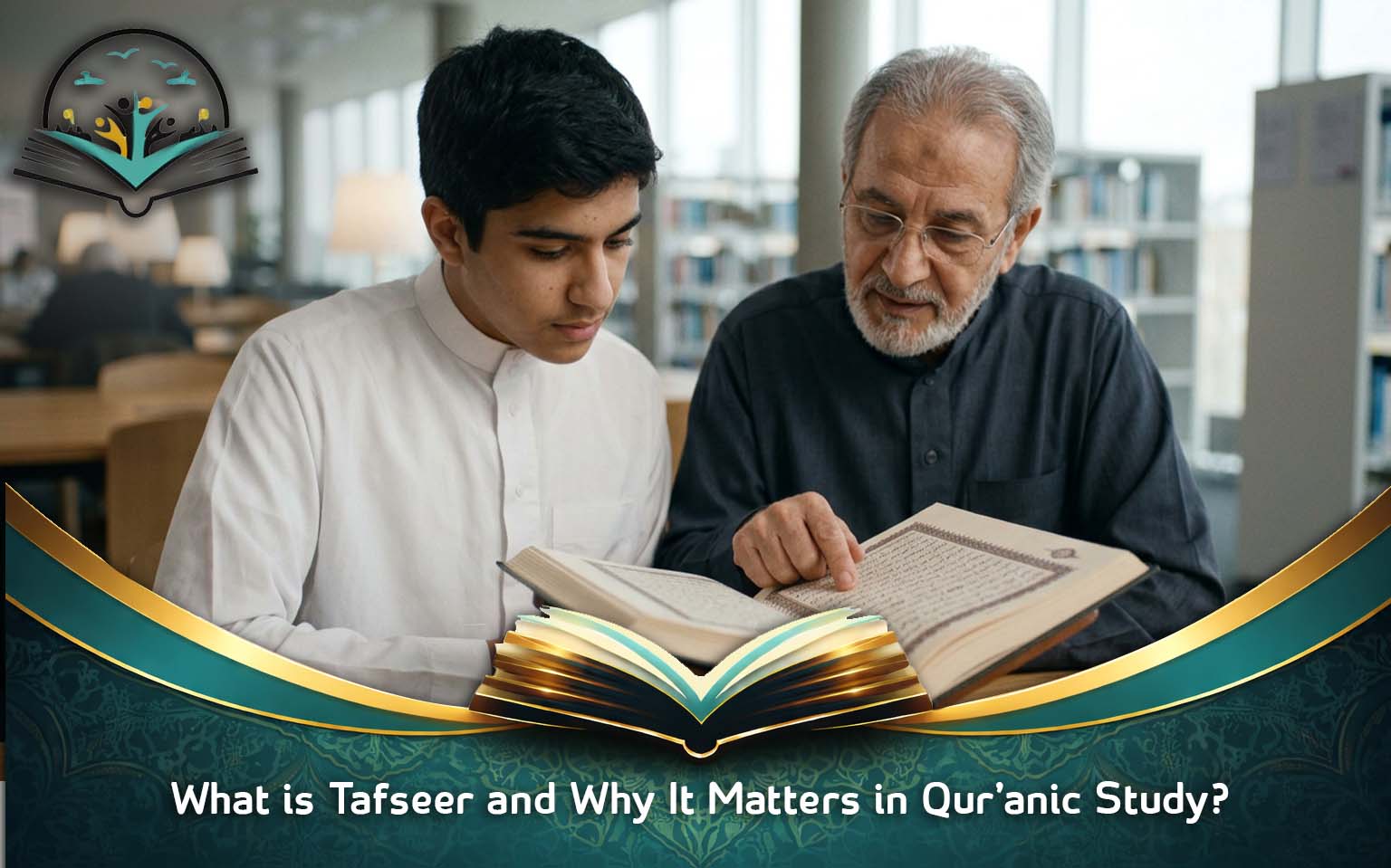
The word tafsir comes from the Arabic root fassara, which carries the meaning of explaining, interpreting, or uncovering something. In Qur’anic studies, tafseer refers to the explanation and interpretation of the verses of the Qur’an.
Therefore, what is Tafseer and Why It Matters can be answered by looking at the purpose of this discipline. Tafseer seeks to clarify what Qur’anic verses mean, explain relevant context, examine linguistic details, and show how scholars understand the guidance contained within the revelation. Tafseer al-Qur’an can include several areas of study, such as:
- The meanings of Qur’anic words and expressions.
- The circumstances surrounding revelation.
- Connections between related Qur’anic verses.
- Explanations found in authentic Hadith.
- Statements transmitted from the Companions and early scholars.
- Legal, theological, ethical, and spiritual implications.
- Linguistic and rhetorical features of the Arabic text.
Consequently, tafseer is more than a simple explanation of vocabulary. It is a scholarly field that brings different forms of knowledge together to help readers approach the Qur’an with greater understanding.
Begin Your Spiritual Journey With Trusted Quran Guidance
Take the next step toward deeper Quran understanding with Rattel W Artaqi Quran Academy and start learning with confidence today. Our experienced teachers provide supportive online classes designed for children, adults, and beginners who want to improve recitation, Tajweed, and Islamic knowledge.
We focus on clear explanations, flexible schedules, and practical learning that fits your daily life. Join our academy now and build a stronger connection with the Holy Quran through engaging lessons that inspire spiritual growth, discipline, and lasting faith for every student.

What is Tafseer and Why It Matters Beyond Translation?
A translation gives readers access to the general meaning of Qur’anic words in another language. That makes translation extremely useful, particularly for people who do not speak Arabic. Nevertheless, a translation cannot always communicate every linguistic, historical, rhetorical, or interpretive detail contained in the original Arabic.
This distinction is central to understanding What is Tafseer and Why It Matters. Translation primarily transfers meaning from one language to another, while tafseer examines the meaning more deeply and explains how that meaning is understood within the wider Qur’anic and Islamic tradition. Consider the difference in purpose:
- Translation: Presents the meaning of the Qur’anic wording in another language.
- Tafseer: Explains the verse, its context, linguistic features, related evidence, and possible implications.
- Qur’anic study: Can combine reading the Arabic text, translation, tafseer, and reflection.
A reader may therefore use a translation as an entry point while turning to reliable tafseer for deeper explanation. This approach is especially useful when a verse contains terminology, historical context, legal implications, or linguistic details that cannot be fully represented by a short translation.
Why is Tafseer Important for Understanding the Qur’an?
The importance of tafseer becomes clearer when readers encounter verses that require context or detailed explanation. Some passages are straightforward, while others involve linguistic depth, historical circumstances, legal questions, or meanings that must be considered alongside other evidence.
When asking what Tafseer is and why it matters, one major answer is that tafseer helps readers avoid reducing a complex Qur’anic message to an isolated sentence or personal interpretation.
Tafseer can help with:
Clarifying Difficult Meanings
Some Qur’anic expressions require explanation because their meaning depends on Arabic usage, context, or related verses. Tafseer gives the reader a more informed way to approach such passages.
Understanding the Circumstances of Revelation
The circumstances in which particular verses were revealed can provide important context. Knowing the relevant background may help explain why a verse addressed a particular situation and how scholars understood its application.
Exploring Arabic Linguistic Features
The Qur’an was revealed in Arabic, and Arabic expressions can carry layers of meaning. Scholars therefore examine vocabulary, grammar, rhetoric, and usage when explaining verses.
Connecting the Qur’an With Hadith
The Prophet Muhammad, peace be upon him, explained aspects of the Qur’an to his Companions. Tafseer may therefore draw upon relevant Hadith when explaining particular verses.
Understanding Legal and Ethical Guidance
Some Qur’anic passages address matters such as family relationships, justice, commerce, inheritance, and other areas of conduct. Tafseer helps explain how scholars approach such verses and their implications.
For these reasons, the answer to What is Tafseer and Why It Matters is closely connected to responsible Qur’anic understanding rather than simply collecting isolated explanations.
What is Tafseer and Why It Matters for Avoiding Misinterpretation?
The Qur’an is often discussed through short quotations, social media posts, translations, or isolated verses. Although these formats can introduce people to Qur’anic teachings, they may not provide enough context to explain a verse fully.
Tafseer offers a more disciplined approach. Instead of relying only on an individual's immediate impression, students can examine how qualified scholars understood a verse and what evidence supports that interpretation.
This does not mean that every tafseer work contains exactly the same explanation. Scholars may differ in methodology, emphasis, and interpretation. However, those differences can be studied within established Islamic disciplines rather than through unsupported personal speculation. A responsible student should therefore consider:
- The source of the tafseer.
- The methodology followed by its author.
- The evidence used to explain the verse.
- Relevant Qur’anic passages.
- Authentic Hadith and Prophetic explanations.
- Statements of the Companions and early generations.
- The linguistic context of the Arabic text.
This method makes Qur’anic study more careful and helps students distinguish between established interpretation and personal opinion.
What is Tafseer and Why It Matters in the History of Islam?
Tafseer began during the lifetime of the Prophet Muhammad, peace be upon him. As the first recipient and teacher of the revelation, he explained Qur’anic verses to his Companions and showed them how the guidance was applied.
After his death, the Companions continued transmitting their knowledge. Figures such as Ibn Abbas became particularly associated with Qur’anic interpretation. Later generations, including the Tabi’un, contributed to the development and preservation of tafseer knowledge.
Over time, scholars produced extensive tafseer works covering language, Hadith, jurisprudence, theology, history, and other areas of Qur’anic study. Among the well-known classical works are:
- Tafsir al-Tabari
- Tafsir al-Qurtubi
- Tafsir Ibn Kathir
- Al-Kashshaf
- Al-Jalalayn
These works represent important parts of the long scholarly tradition surrounding Qur’anic interpretation. Their continued study also demonstrates that tafseer is not a modern concept created for online learning. Rather, it has developed through centuries of scholarship.
What are the Main Types of Tafseer?
There is no single method through which every tafseer work approaches the Qur’an. Scholars have used different approaches depending on their objectives, evidence, and areas of expertise.
Understanding these approaches adds another dimension to What is Tafseer and Why It Matters, because it shows why different tafseer books may emphasize different aspects of the same verse.
Tafsir Bil-Ma’thur
This approach relies heavily on transmitted sources, including the Qur’an itself, Prophetic Hadith, explanations of the Companions, and statements from early scholars.
Tafsir Bil-Ra’y
This approach involves reasoned interpretation supported by Arabic language, Islamic principles, and scholarly knowledge. It is not simply unrestricted personal opinion; rather, it requires appropriate qualifications and must remain consistent with established Islamic teachings.
Tafsir Al-Ishari
Some tafseer works explore spiritual or allegorical dimensions of verses. Such interpretations are expected to remain consistent with Islamic principles rather than contradict established meanings.
Tafsir Fiqhi
This approach focuses particularly on verses connected with Islamic jurisprudence and legal rulings. It examines how scholars understand Qur’anic guidance concerning practical matters.
Modern Tafseer
Contemporary works may address questions faced by Muslims today while drawing on established methods of Qur’anic interpretation. These works can make classical discussions more accessible to modern readers.
What is Tafseer and Why It Matters in the Scholar’s Method?
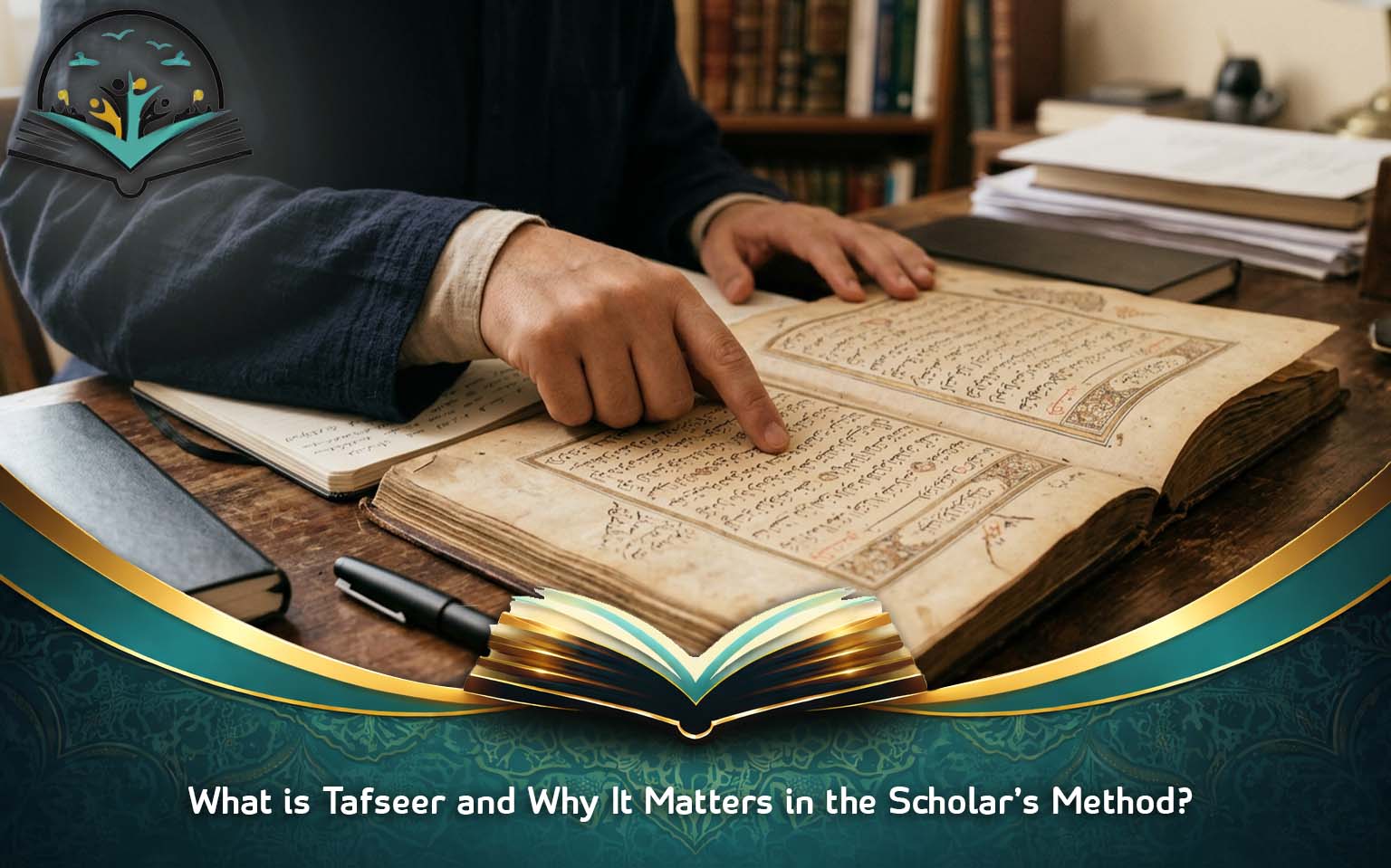
A deeper answer to What is Tafseer and Why It Matters requires understanding that qualified tafseer is not normally produced by reading a verse and immediately assigning a personal meaning to it. Scholars approach Qur’anic interpretation through a range of disciplines. Their work may involve:
- Arabic language analysis to examine vocabulary, grammar, syntax, and rhetorical structures.
- Study of revelation context to understand relevant historical circumstances.
- Comparison with other Qur’anic verses because one passage may clarify another.
- Reference to Hadith and Sunnah where Prophetic explanations are relevant.
- Consultation of early scholarly reports from the Companions and Tabi’un.
- Reasoned scholarly analysis when addressing questions that require interpretation.
This methodology demonstrates why tafseer should not be confused with an individual's personal reaction to a translation. It is a field requiring knowledge, evidence, and careful study.
How Does Tafseer Connect the Qur’an With Daily Life?
The value of tafseer does not end when a student finishes reading a commentary. Its deeper purpose is to help believers understand revelation and apply its guidance consciously.
For example, understanding Qur’anic verses about patience can influence how a person responds to difficulty. Studying verses about justice can shape ethical decisions. Reflecting on verses concerning gratitude can affect a person's attitude toward blessings.
In this sense, What is Tafseer and Why It Matters has a practical dimension. Tafseer can connect knowledge of the Qur’an with worship, character, relationships, and personal decisions. Its practical areas include:
- Worship: Understanding the meanings of verses recited during prayer can strengthen concentration.
- Character: Qur’anic teachings can encourage qualities such as patience, humility, justice, and compassion.
- Personal reflection: Explanation can help readers consider how a verse relates to their own choices.
- Social conduct: Qur’anic principles can guide attitudes toward justice, responsibility, and relationships.
- Spiritual growth: Deeper understanding can turn reading into more conscious reflection.
The goal is therefore not simply to accumulate information. It is to understand revelation in a way that supports thoughtful practice.
Tafseer in Arabic and English: Which Should You Study?
Arabic remains central to Qur’anic study because the Qur’an was revealed in Arabic. Students who develop their Arabic skills can gradually access linguistic details that may be difficult to communicate completely through translation.
At the same time, tafsir in English can provide an important starting point for readers who are not yet comfortable with Arabic. A reliable English commentary can help students understand the broad meaning of verses while they continue developing their language skills. A practical learning path might include:
- Reading the Qur’an in Arabic when possible.
- Using a reliable translation for general meaning.
- Consulting an accessible tafseer.
- Learning relevant Arabic vocabulary.
- Asking qualified teachers about difficult passages.
- Comparing explanations with established scholarly sources.
Students should not feel that they must master Arabic before beginning to learn. Instead, Arabic and tafseer can develop together according to the learner’s level.
What is Tafseer and Why It Matters for Modern Muslims?
Modern Muslims encounter Qur’anic questions in an environment shaped by technology, social media, changing cultural norms, and rapid access to information. As a result, people can encounter many interpretations without knowing how those interpretations were developed.
This makes What Tafseer Is and Why It Matters especially relevant to contemporary Qur’anic education. Tafseer provides a framework for returning to established sources and studying verses with greater context. Alongside tafseer, understanding the broader process of Qur’anic learning can help students distinguish between memorization, recitation, and deeper comprehension. For example, knowing the Difference Between Hifz and Tajweed can clarify why memorizing the Qur’an and learning correct recitation represent different areas of study. Modern discussions may involve:
- Questions about ethics and technology.
- Family and social relationships.
- Justice and personal responsibility.
- Faith and contemporary intellectual questions.
- The relationship between religious teachings and modern life.
A sound approach does not require forcing every modern question into a verse. Instead, it involves studying the Qur’anic guidance carefully and considering what principles can be applied to contemporary circumstances. Choosing an appropriate learning environment can also make this process more organized, particularly for students who need structured guidance when studying Qur’an online.
Online resources can make this process more accessible. Students may find digital libraries, recorded lessons, searchable commentaries, and online classes that allow them to study from home. Before joining a program, however, learners can benefit from reviewing practical criteria explained in How to Choose the Right Online Quran Academy.
How Can Beginners Start Studying Tafseer?
Someone encountering what Tafseer is and why it matters for the first time may wonder where to begin. The answer does not have to involve immediately reading advanced classical works from beginning to end.
A gradual path is often easier to sustain. Beginners can start with basic explanations and then develop their knowledge through regular reading, guided lessons, and reflection. This approach also allows students to build supporting Qur’anic skills at a manageable pace.
Start With a Reliable Translation
Choose a translation that provides a clear rendering of the Qur’anic meaning. Read slowly rather than trying to cover large sections without reflection.
Add an Accessible Tafseer
Once the general meaning is clear, consult a trustworthy tafseer to understand context, terminology, and scholarly explanations. At this stage, students should also recognize that understanding Qur’anic meaning is different from simply improving pronunciation.
Progress to Classical Works
Students with a stronger foundation can explore classical commentaries. Works such as Tafsir Ibn Kathir and Tafsir al-Tabari represent major parts of the traditional tafseer literature.
Study Arabic Gradually
Learning Qur’anic Arabic can improve access to vocabulary, grammar, and rhetorical features. Even gradual progress can make later study more rewarding.
Learn With Guidance
A structured class can help beginners identify reliable sources, ask questions, and avoid becoming overwhelmed by differences between advanced commentaries. It can also connect tafseer with other essential areas of Qur’anic education, including the Importance of Learning Quran with Tajweed, so that students develop understanding alongside accurate recitation.
Reflect on What You Learn
Finally, tafseer should not remain purely theoretical. Ask how the guidance affects worship, character, decisions, and relationships.
What is Tafseer and Why It Matters for Spiritual Growth?
Tafseer can change the experience of reading the Qur’an. Instead of encountering verses only as words to recite, students begin to recognize meanings, themes, connections, and guidance.
Understanding the meanings of verses used in Salah, for instance, may help a worshipper become more attentive to what is being recited. Likewise, studying Qur’anic teachings about patience, mercy, gratitude, repentance, and justice can make personal reflection more focused.
The spiritual value of tafseer therefore develops through a combination of knowledge and reflection. The learning experience can also be influenced by the relationship between a student and teacher, particularly when learners are considering whether different teaching approaches suit their needs. A learner may notice:
- Greater awareness of Qur’anic themes.
- More thoughtful reading.
- A stronger connection between verses and personal conduct.
- Better understanding of Islamic concepts.
- Greater appreciation for the Arabic language of revelation.
However, spiritual growth is not produced by information alone. The learner also needs sincerity, reflection, and a willingness to apply beneficial knowledge. Personal comfort can also matter when selecting a teacher, which is why some students may consider Female vs Male Quran Teachers Which is Better before choosing a suitable learning arrangement.
What is Tafseer and Why It Matters for Different Learners?

Tafseer can serve learners with different backgrounds and goals. A new Muslim may need clear explanations of basic concepts, while a more experienced student may want to explore classical methodology or linguistic details.
For non-Arabic speakers, English tafseer can make Qur’anic study more accessible. New Muslims can use it to build a foundation for understanding their faith. Students of Arabic can use tafseer as an additional way to connect language study with Qur’anic vocabulary and expression.
More advanced learners may use classical works to compare scholarly approaches and investigate how different disciplines influenced Qur’anic interpretation.
This flexibility means that What is Tafseer and Why It Matters does not have one identical answer for every learner. The central purpose remains understanding the Qur’an responsibly, but the appropriate learning path can change according to language ability, prior knowledge, age, and study goals.
Consistency is another part of successful Qur’anic learning. Students who create realistic routines and maintain regular review may find it easier to continue developing their knowledge over time. Practical strategies for maintaining that routine are discussed in How to Stay Consistent in Quran Memorization.
How Can Rattel W Artaqi Quran Academy Support Tafseer Learning?
Students who want structured Qur’anic study may benefit from learning with Rattel W Artaqi Quran Academy as part of a guided educational journey. A structured environment can provide learners with a clear starting point instead of leaving them to navigate a large number of online resources alone.
For beginners, guidance can make it easier to organize reading, understand unfamiliar terminology, and develop a consistent study routine. More experienced learners may also benefit from having a teacher available when a passage requires additional explanation. A guided learning experience can include:
- Lessons adapted to the student's current level.
- Teacher-led explanation and discussion.
- Opportunities to ask questions.
- A structured progression through Qur’anic topics.
- Regular practice and reflection.
The purpose is not to replace independent reading. Rather, Rattel W Artaqi Quran Academy can provide an educational framework that helps students approach their Qur’anic studies with greater consistency.
When selecting an online learning environment, students should consider the teacher's qualifications, lesson structure, communication style, curriculum, and whether the teaching approach matches their learning objectives.
What Should You Look for in an Online Tafseer Class?
Choosing an online tafseer class requires more than looking for a convenient schedule. The quality of the educational approach matters because Qur’anic interpretation involves language, context, sources, and scholarly methodology. Before joining a class, consider asking:
- Who teaches the lessons?
- What sources are used?
- Is the course designed for beginners or advanced students?
- How are difficult interpretations explained?
- Can students ask questions during lessons?
- Does the course follow a clear progression?
- Is Arabic knowledge required at the beginning?
- How are classical and contemporary sources presented?
Rattel W Artaqi Quran Academy can be considered by learners seeking a structured online environment for Qur’anic learning. However, students should always review the course structure and ensure that it fits their own level and goals before beginning.
A good learning experience should leave students with clearer questions, better study habits, and a stronger ability to engage with Qur’anic teachings responsibly.
Common Misconceptions About Tafseer
Several common misunderstandings about tafseer can make Qur’anic study more challenging, especially for beginners who are unfamiliar with its methods and sources.
Tafseer Is Only for Scholars
Scholars may specialize in tafseer, but ordinary Muslims can still study explanations appropriate to their level. The key is to learn from reliable sources rather than treating personal interpretation as equivalent to scholarly interpretation.
A Translation Is Always Enough
Translation is valuable, but it cannot necessarily communicate every detail of the Arabic text or the scholarly context behind a verse.
Every Tafseer Opinion Has Equal Weight
Different scholarly interpretations should not automatically be treated as equally authoritative. Students should consider the methodology, evidence, and scholarly tradition behind each explanation.
Tafseer Is Only Academic
Although tafseer is a scholarly discipline, its lessons can influence worship, ethics, character, and personal reflection. Its value extends beyond academic information.
What is Tafseer and Why It Matters for a Lifelong Qur’anic Journey?
The study of tafseer does not necessarily end after completing one book or course. The Qur’an contains broad themes and layers of meaning that students may continue exploring throughout their lives.
As learners develop their Arabic skills and become familiar with Qur’anic sciences, they can gradually approach more advanced sources. They may compare commentaries, investigate particular verses, or study how scholars addressed different questions.
This lifelong approach also changes how students read familiar passages. A verse encountered repeatedly may take on new significance when the reader gains a better understanding of its vocabulary, context, or relationship to other passages.
Therefore, What is Tafseer and Why It Matters is not simply a definition-based question. It points toward a method of engaging with the Qur’an through knowledge, reflection, and continued learning.
The Qur’an encourages believers to contemplate its message. Tafseer supports that process by giving readers tools for understanding what they encounter rather than treating every passage as an isolated statement.
Tafseer as a Path to Deeper Quranic Understanding
The continued relevance of tafseer comes from the Qur’an’s role as a source of guidance across different times and circumstances. Tafseer helps readers understand how scholars have approached the revelation and how its principles relate to human concerns such as justice, morality, family, responsibility, worship, and personal conduct.
Modern technology has also changed access to tafseer. A learner no longer needs physical access to a large library to find explanations. Digital resources can provide searchable texts, recorded lessons, educational articles, and online classes.
Nevertheless, accessibility should not be confused with reliability. Having thousands of explanations available online makes source evaluation more important, not less.
Students should therefore combine the convenience of digital learning with careful attention to the credibility and methodology of the material they use.
Frequently Asked Questions
Here are some frequently asked questions about tafseer, its purpose, and how beginners can approach Qur’anic interpretation with greater understanding.
Can I study tafseer if I have never studied Islamic sciences?
Yes. A beginner can start with introductory material designed for their level. Advanced tafseer works may require more background knowledge, so progressing gradually can make the learning experience easier.
How much time should I dedicate to tafseer each week?
There is no single schedule that suits everyone. A short, consistent study session can be more useful than occasional long sessions. The right amount depends on your existing Qur’an knowledge, other commitments, and learning goals.
Should I take notes while studying tafseer?
Taking notes can help you remember unfamiliar terms, questions, important explanations, and connections between verses. A simple notebook or digital document can make it easier to review what you have learned later.
How can I tell whether a tafseer explanation is suitable for beginners?
Look for material that explains terminology clearly, identifies its sources, follows a recognizable methodology, and does not assume advanced knowledge. Beginner-friendly material should help you understand the subject without overwhelming you with unexplained technical details.
In conclusion, What is Tafseer and Why It Matters is ultimately a question about understanding the Qur’an beyond its translated words. Tafseer helps readers explore the meanings of verses, their context, linguistic details, Prophetic guidance, and the lessons they offer for faith and daily life.
For beginners, studying tafseer gradually can make Qur’anic learning clearer and more meaningful. Starting with a reliable translation, then exploring accessible tafseer, learning Qur’anic Arabic, and studying with qualified guidance can build a strong foundation for deeper understanding.
With Rattel W Artaqi Quran Academy, learners can pursue a structured approach to Qur’anic education while developing their understanding step by step. Whether you are beginning your study of tafseer or seeking to deepen your existing knowledge, consistent learning and reflection can help you engage with the Qur’an more thoughtfully.
Ultimately, tafseer is not simply about explaining individual verses. It is about developing a deeper relationship with Allah’s revelation and allowing its guidance to inform worship, character, reflection, and everyday life.
Add New Comment