 العربية
 English

What is Ijazah in Quran Recitation is a question many Quran learners ask when they begin considering advanced Quran study and teaching. An Ijazah is traditionally a formal authorization given by a qualified Quran teacher to a student who has demonstrated accurate recitation according to a specific reading and transmission. It is not simply a certificate of attendance or proof that someone completed a course. Instead, it represents direct learning, careful evaluation, and a connection between the student and a recognized chain of Quran teachers.
For many Muslims, the idea of receiving an Ijazah raises several practical questions. What does the authorization actually mean? Does a student have to memorize the entire Quran? How does the assessment work? Can the process be completed online? Furthermore, what should a learner look for when choosing a teacher?
This guide answers those questions in a clear and practical way. It explains the meaning of Ijazah, the role of the sanad, the main types, common requirements, the learning process, online study considerations, and what learners should evaluate before beginning their journey.
What is Ijazah in Quran Recitation and Why Does It Matter?
What is Ijazah in Quran Recitation becomes easier to understand when the difference between learning and authorization is clear. A person can learn how to read the Quran, study Tajweed, and improve pronunciation without necessarily receiving an Ijazah.
An Ijazah goes a step further. It indicates that a qualified teacher has listened to the student's recitation and determined that the learner has reached the required standard for the particular Ijazah being granted.
The process is therefore based primarily on demonstrated recitation rather than a written examination. The teacher listens carefully to pronunciation, articulation, Tajweed rules, stopping and starting points, and other elements relevant to the chosen reading.
An Ijazah may also identify the specific Riwayah or Qira'ah covered by the authorization. Consequently, the scope of the permission should always be understood before assuming that one Ijazah covers every Quranic reading.
For someone researching advanced Quran education, the key point is simple: an Ijazah represents verified learning through a teacher rather than independent study alone.
Begin Your Spiritual Journey With Trusted Quran Guidance
Take the next step toward deeper Quran understanding with Rattel W Artaqi Quran Academy and start learning with confidence today. Our experienced teachers provide supportive online classes designed for children, adults, and beginners who want to improve recitation, Tajweed, and Islamic knowledge.
We focus on clear explanations, flexible schedules, and practical learning that fits your daily life. Join our academy now and build a stronger connection with the Holy Quran through engaging lessons that inspire spiritual growth, discipline, and lasting faith for every student.
Understanding the Sanad Behind an Ijazah
The sanad is one of the most important concepts connected with Quranic Ijazah. In simple terms, it refers to a chain of transmission connecting a student to previous teachers.
A student learns from a teacher. That teacher learned from another qualified teacher, who in turn learned from someone before them. The chain continues through generations of Quran teachers. Depending on the Ijazah and its documentation, the chain ultimately connects through recognized transmitters to the Prophet Muhammad ﷺ.
This system gives Quran recitation a strong oral dimension. The written Mushaf preserves the text, while direct recitation with a qualified teacher helps preserve pronunciation, articulation, Tajweed, and transmitted reading practices.
Historically, Quran learning has involved listening and reciting back to a teacher. The learner does not simply look at written symbols and decide independently how every word should sound. Instead, the teacher hears the student and corrects mistakes.
That relationship is particularly important when studying for an Ijazah. The learner needs someone capable of distinguishing subtle errors that may not be obvious to an inexperienced reader.
Therefore, when considering an Ijazah program, the sanad of the teacher deserves careful attention. A learner should understand who the teacher studied with and what authorization the teacher holds.
What is Ijazah in Quran Recitation According to the Traditional Learning Method?
Ijazah in Quran Recitation can also be understood through the traditional concept of talaqqi. Talaqqi means receiving the Quran directly through listening to and reciting to a teacher.
The method is practical. The student reads or recites, while the teacher listens. When a mistake occurs, the teacher identifies it and provides the correct pronunciation or recitation. The student then repeats the passage until the correction becomes reliable.
This approach differs from studying Tajweed exclusively through books or recorded lessons. Written resources are useful because they explain rules and terminology. However, they cannot always identify whether a learner is actually applying those rules correctly while reciting.
For that reason, an Ijazah journey normally requires sustained interaction with a qualified teacher. The learner gradually develops greater accuracy and consistency instead of simply completing lessons as quickly as possible.
The traditional method also encourages patience. Quran recitation is an oral skill, so improvement often requires repeated practice, listening, correction, and revision.
Types of Ijazah in Quran Recitation
There is no single format that describes every Ijazah. The requirements can differ according to the teacher, reading, and purpose of the authorization. Common categories include the following:
- Ijazah through looking at the Mushaf: The student recites the Quran while reading directly from the Mushaf. This is often referred to as nazaran.
- Ijazah through memorized recitation: The learner recites the Quran from memory. This type requires strong memorization in addition to accurate Tajweed.
- Ijazah in a specific Riwayah: The authorization may cover a particular transmitted reading, such as Hafs 'an 'Asim.
- Ijazah involving advanced Qira'at: Advanced learners may study multiple canonical readings after establishing a strong foundation in Quran recitation.
The exact terminology and requirements can vary between qualified teachers. Therefore, students should ask what the authorization covers before beginning.
An Ijazah for reciting from the Mushaf should not automatically be treated as identical to an Ijazah for memorized recitation. Similarly, authorization in one Riwayah does not necessarily mean authorization in every other reading. The most useful approach is to focus on the specific scope documented by the teacher.
What is Ijazah in Quran Recitation Requirements?
What is Ijazah in Quran Recitation in practical terms? Before a teacher grants authorization, a student generally needs to demonstrate a reliable level of recitation. Although individual teachers may establish different standards, several requirements are commonly important.
Strong Quran Reading Skills
The learner should be able to read Quranic Arabic accurately. Basic difficulty with letters, vowel marks, or connected words can make advanced Ijazah study unnecessarily difficult. A student who still struggles with the Arabic alphabet or basic word formation may benefit from foundational instruction first.
Correct Tajweed
Tajweed is central to accurate Quran recitation. The learner should understand and apply relevant rules rather than simply memorize their names. This includes areas such as articulation points, characteristics of letters, elongations, nasal sounds, rules of noon and meem, and appropriate stopping and starting.
Consistent Pronunciation
Small pronunciation differences can matter significantly in Quran recitation. Therefore, the teacher needs enough time to hear the learner repeatedly and identify recurring weaknesses.
Complete Recitation
Depending on the type of Ijazah, the student may need to recite the entire Quran to the teacher. The teacher evaluates the student's performance throughout the process rather than relying on a short sample.
A Qualified Teacher
The teacher should have appropriate authorization and knowledge for the specific reading being taught. A learner should not assume that someone who teaches Quran automatically has the authority to issue every type of Ijazah.
Patience and Regular Practice
Finally, consistency matters. The process can involve a substantial amount of recitation and revision. Rushing through the material can create weaknesses that become more difficult to correct later.
What is Ijazah in the Quran Recitation Process Step by Step?
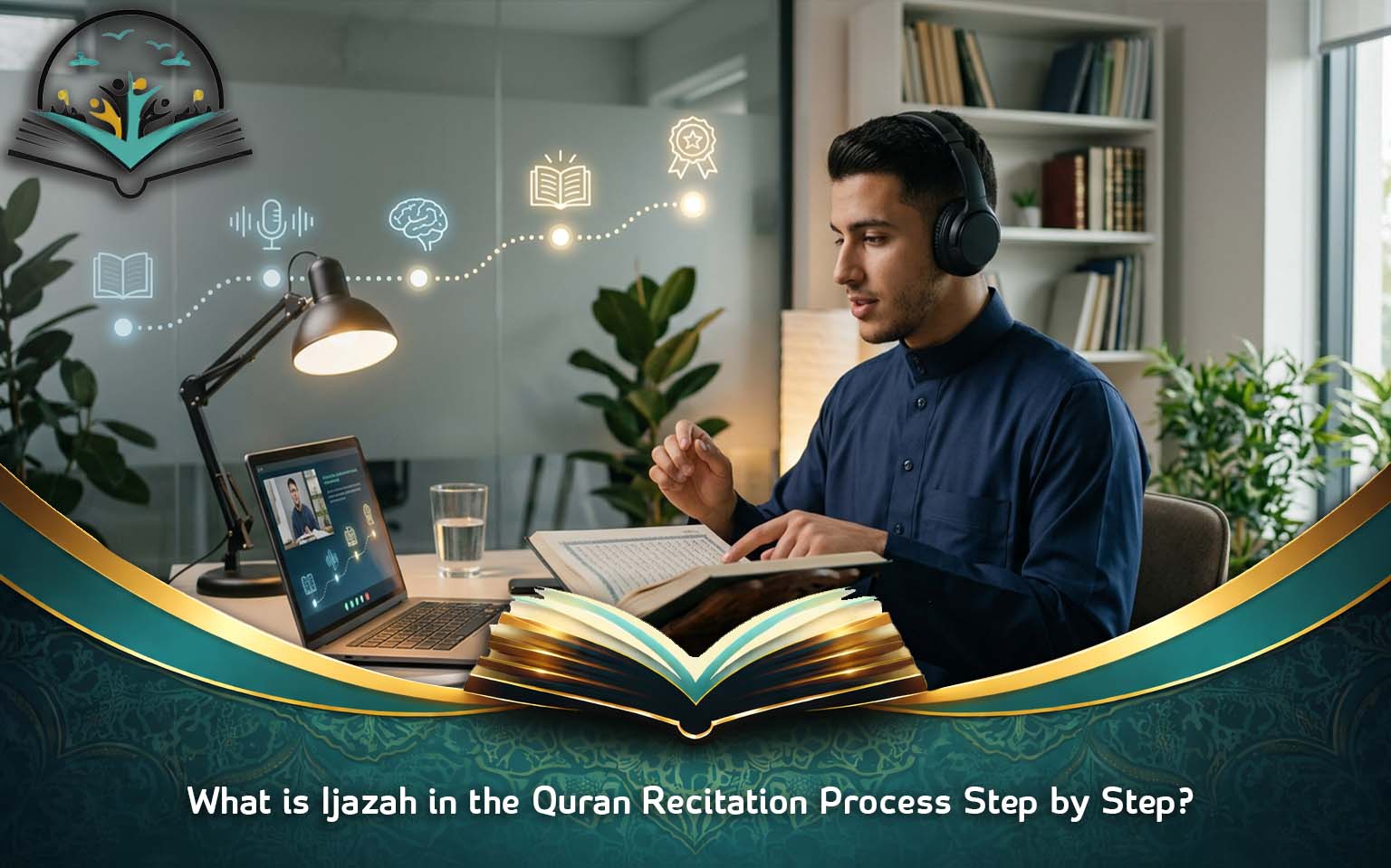
What is Ijazah in Quran Recitation as a learning journey? It can be viewed as a sequence of preparation, supervised recitation, correction, revision, and final authorization.
-
Assess Your Current Level: The first step is determining whether your current reading is ready for an Ijazah track. A qualified teacher can listen to a sample of your recitation and identify the areas that need improvement. This assessment is valuable because learners sometimes overestimate or underestimate their level.
-
Strengthen Your Tajweed: Once the starting level is clear, the student works on pronunciation and Tajweed. Weak areas should be addressed before progressing through large sections of the Quran.
-
Choose the Relevant Reading: The learner should understand which Riwayah or reading will be studied. Many students begin with Hafs 'an 'Asim, although the appropriate choice depends on the student's goals and teacher.
-
Begin Talaqqi: During the main study stage, the learner recites directly to the teacher. Mistakes are corrected during lessons, while difficult passages may require additional practice.
-
Recite the Quran Completely: The learner gradually completes the required recitation. Some students may read from the Mushaf, while others recite from memory, depending on the type of Ijazah.
-
Complete the Teacher's Evaluation: The teacher determines whether the student's recitation has reached the required standard. Additional revision may be requested if weaknesses remain.
-
Receive the Authorization: When the teacher is satisfied, the Ijazah can be granted according to the agreed reading and conditions. The document may include information about the student, teacher, reading, and chain of transmission.
What is Ijazah in Quran Recitation Without Memorizing the Quran?
What is Ijazah in Quran Recitation if the learner has not memorized the entire Quran? The answer depends on the type of authorization and the teacher's requirements.
Some forms of Ijazah involve reciting while looking at the Mushaf. In that case, complete memorization is not necessarily the defining requirement. Instead, the student demonstrates accurate reading of the complete Quran under the supervision of the teacher.
Other teachers may require memorization for the Ijazah they grant. Therefore, learners should never assume that memorization is either universally required or universally unnecessary.
This distinction is especially important for students who can read the Quran well but have not completed Hifz. They may still be able to pursue a suitable recitation-based pathway if the teacher's program permits it.
The correct question is not simply, "Do I need to memorize?" A better question is, "What are the exact requirements of the Ijazah I want to pursue?"
That approach prevents confusion and helps the student choose a realistic learning plan.
Can You Study for an Ijazah Online?
Modern technology has made direct Quran instruction available to learners who do not live near a qualified teacher. As a result, online Quran education can provide a practical route for students seeking structured recitation instruction.
An online Ijazah program should still preserve the essential teacher-student relationship. The student needs to recite live to the teacher, receive immediate corrections, and continue through a structured process.
At Rattel W Artaqi Quran Academy, students can explore a structured approach to Quran learning with teacher guidance and individual attention. The focus should remain on the learner's actual recitation rather than simply completing online lessons.
However, learners should investigate an academy before enrolling. A professional website alone does not establish the credentials of a teacher.
Look for:
- The teacher's Quranic qualifications.
- The specific Ijazah or Riwayah they hold.
- Whether live one-to-one recitation is available.
- How the student's level is assessed.
- How mistakes are documented and corrected.
- Whether the program explains its requirements clearly.
- What happens before the final authorization.
These checks make it easier to distinguish a serious Ijazah pathway from a general Quran course.
Choosing a Teacher for an Ijazah Program
Choosing the teacher is arguably one of the most important decisions in the entire process. The quality of the teacher affects the accuracy of the learner's recitation and the credibility of the final authorization. For students beginning to study Quran online, evaluating the teacher's qualifications should come before focusing on lesson schedules or other practical details.
A learner should therefore ask direct questions before starting. For example, ask which Riwayah the teacher teaches and what Ijazah they personally hold. It is also useful to ask whether their sanad is documented and whether they have experience guiding students through complete Quran recitation.
At Rattel W Artaqi Quran Academy, learners can begin by discussing their current level and intended Quran learning goal. That initial conversation can help determine whether the student needs foundational Tajweed, advanced recitation practice, memorization support, or a dedicated Ijazah pathway.
Furthermore, the teacher's correction style matters. A strong teacher should be able to explain an error clearly rather than merely saying that a recitation is wrong. This approach is particularly useful for learners who want to learn Tajweed Quran through consistent correction and guided practice.
The right teacher should also understand that students progress at different speeds. Someone who needs additional revision should not be pushed forward simply to meet an artificial schedule.
How Long Does an Ijazah Journey Take?
There is no universal timetable for completing an Ijazah. The duration depends on several factors, including the learner's starting level, lesson frequency, reading ability, memorization status, Tajweed accuracy, and the requirements established by the teacher. Students who want to learn Quran online should therefore understand that progress depends more on consistency and accuracy than on completing lessons quickly.
A student who already reads fluently and applies Tajweed consistently will generally begin from a different position than someone who still struggles with pronunciation.
Lesson frequency also matters. Regular sessions allow the teacher to identify patterns and monitor progress. In contrast, irregular attendance can make revision more difficult. A consistent routine can also support learners who are exploring how to learn Quran fast while still maintaining accurate recitation.
The total amount of recitation is another factor. Completing the Quran under teacher supervision naturally requires time, particularly when the teacher stops frequently to correct mistakes.
Therefore, students should be cautious about programs that promise an advanced authorization within an unrealistically short period.
At Rattel W Artaqi Quran Academy, the more useful approach is to evaluate progress according to the student's actual recitation. The objective should be reliable Quran reading rather than simply reaching a predetermined completion date.
What Does an Ijazah Certificate Usually Contain?
An Ijazah document can contain several pieces of information that establish what the authorization represents.
Depending on the teacher and tradition, it may include:
- The student's name.
- The teacher's name.
- The Quranic reading or Riwayah.
- Details about the student's recitation.
- The teacher's authorization statement.
- The chain of transmission or sanad.
- The date of issuance.
- The teacher's signature or seal.
The exact format is not necessarily identical from one teacher to another. Some documents may be highly detailed, while others may be more concise.
More importantly, the document should accurately describe what the student has been authorized to do. A certificate should not imply authorization in a reading that the learner has not actually studied and demonstrated.
For this reason, students should focus on the substance of the authorization rather than the visual appearance of the certificate. Learners studying learning Quran in Arabic may also benefit from understanding the terminology used in their Ijazah and the specific reading covered by it.
What are the Benefits of Earning an Ijazah?
An Ijazah can represent a significant stage in a learner's Quran journey. Its value comes from demonstrated competence, teacher supervision, and connection to a transmission tradition.
Verified Recitation
The learner receives qualified confirmation that their recitation has been examined. This can provide confidence that pronunciation and Tajweed have been carefully reviewed.
Deeper Understanding of Quran Transmission
Studying through a teacher introduces the learner to the oral tradition that has played an important role in Quran education across generations.
Preparation for Teaching
Depending on the authorization, an Ijazah may permit the holder to teach the specific reading in which they were authorized. However, teaching ability also involves communication skills, patience, lesson planning, and responsibility toward students.
Personal Discipline
Completing a full Quran recitation under supervision requires consistency. The learner develops habits of revision, listening, repetition, and careful attention to detail.
Continued Quranic Development
Receiving one Ijazah does not have to mean the end of Quran study. A learner may continue improving Tajweed, studying another Riwayah, pursuing advanced Qira'at, or developing teaching skills.
Common Mistakes Students Should Avoid
The desire to receive an Ijazah can sometimes cause learners to focus too heavily on the final certificate. That approach can weaken the learning experience.
One common mistake is choosing a program because it promises a quick completion. Quranic accuracy should take priority over speed.
Another problem is assuming that watching recorded lessons is enough. Recorded material can support learning, but it cannot replace the individualized correction that comes from live recitation with a qualified teacher.
Some students also focus exclusively on memorization while neglecting pronunciation. Strong Hifz is valuable, yet memorizing an incorrect pronunciation can make later correction harder.
Likewise, learners should not assume that every Quran teacher is qualified to issue an Ijazah. Teaching Quran and granting a specific authorization are related but distinct responsibilities.
Finally, students should avoid comparing their progress too closely with other learners. A person's previous Quran education, available practice time, and reading ability all affect the pace of progress.
How Rattel W Artaqi Quran Academy Can Support Your Quran Journey
Rattel W Artaqi Quran Academy can serve as a structured starting point for learners who want guided Quran education rather than completely independent study.
The appropriate path depends on the student's current abilities. A beginner may first need Arabic reading and foundational Tajweed. Another learner may already read fluently but require detailed correction before beginning advanced recitation.
For that reason, a useful starting point is an individual assessment. The teacher can listen to the learner and identify pronunciation problems, Tajweed weaknesses, fluency issues, and areas that require revision.
Students interested in an Ijazah pathway should also discuss their specific objective from the beginning. They may want an Ijazah through recitation from the Mushaf, a memorization-based route, or preparation for more advanced Quranic readings.
At Rattel W Artaqi Quran Academy, the learning process can be approached progressively, allowing students to strengthen their foundations before moving toward more advanced study.
Most importantly, the learner should understand that an Ijazah is not merely a final document. It represents a learning relationship built around accurate recitation, direct correction, and responsibility.
What is Ijazah in Quran Recitation Worth to a Serious Learner?
What is Ijazah in Quran Recitation worth depends largely on what the learner wants to achieve. For someone who simply wants to improve basic Quran reading, an Ijazah may be more advanced than necessary. A focused Tajweed course could be the better first step.
For a learner who wants formal authorization to transmit a particular Quranic reading, however, the Ijazah can represent an important milestone.
It provides a structured reason to refine recitation carefully and complete the Quran under qualified supervision. Moreover, the learner becomes more aware of the responsibility involved in transmitting Quran recitation to another person.
At Rattel W Artaqi Quran Academy, students can discuss their objectives before choosing an appropriate learning route. This helps prevent a common problem in Quran education: starting an advanced program before the necessary foundation is ready.
The most meaningful achievement is therefore not simply possessing a certificate. Rather, it is developing a reliable recitation that has been examined by a qualified teacher and understanding exactly what the resulting authorization represents.
Who Should Pursue Ijazah in Quran Recitation?

What is Ijazah in Quran Recitation may sound like a question for advanced students only. In reality, anyone interested in the traditional transmission of Quran recitation can learn about the concept. However, pursuing an Ijazah requires commitment and should match the learner's long-term goals. It may be suitable for someone who:
- Reads the Quran confidently.
- Wants detailed Tajweed correction.
- Is willing to recite extensively to a teacher.
- Wants to study a particular Riwayah.
- Plans to teach Quran after reaching the required level.
- Values learning through direct teacher supervision.
- Is prepared for a long-term learning process.
On the other hand, a beginner should not feel pressured to pursue an Ijazah immediately. Building correct pronunciation and basic Tajweed first can create a much stronger foundation.
With guidance from Rattel W Artaqi Quran Academy, learners can identify the stage that best matches their current ability and future objective.
Frequently Asked Questions
Here are answers to the most common questions learners ask about Quran Ijazah, its requirements, study process, and what to expect before beginning this journey.
Can an Ijazah be transferred from one Riwayah to another?
No. Authorization in one Riwayah does not automatically grant authorization in another. Each reading has its own transmission and study requirements, so a learner interested in another Riwayah should study it with a qualified teacher.
Does receiving an Ijazah mean a person must become a Quran teacher?
No. Receiving an Ijazah does not obligate someone to teach professionally. A person may pursue it for personal development, preservation of recitation, scholarly study, or a desire to strengthen their connection with the Quran.
Can a learner lose an Ijazah after receiving it?
The authorization itself is not normally treated like a temporary qualification that expires. However, a teacher may set conditions concerning what the student is authorized to transmit. Continued practice is also important because a person who stops reciting may experience a decline in accuracy.
Is an Ijazah the same as a university degree?
No. An Ijazah belongs to a traditional system of Quranic authorization and should not automatically be compared with a government-accredited academic degree. Its significance comes from the teacher, the transmitted reading, the assessment, and the documented chain behind the authorization.
Final Thoughts
What is Ijazah in Quran Recitation ultimately comes down to authorized transmission through qualified Quran study. It is more than attending lessons and more than receiving a beautifully designed certificate. The learner must demonstrate accurate recitation according to the requirements of the specific Ijazah.
The journey normally involves assessment, Tajweed development, direct recitation, continuous correction, complete Quran review, and final evaluation. Depending on the pathway, memorization may or may not be required.
Online learning can make this type of study more accessible, provided that the essential teacher-student relationship remains in place and the teacher's qualifications are clear.
For learners considering this path, Rattel W Artaqi Quran Academy can provide a structured environment for discussing current ability, Quran learning goals, and the appropriate next stage.
Rather than focusing only on how quickly an Ijazah can be obtained, focus on the quality of the recitation you will develop along the way. A carefully learned Quran reading, corrected by a qualified teacher and practiced consistently, gives the journey its real value.
Add New Comment